
Custom OEM Metal Pens Manufacturer & Global Supplier
Minimum order quantity is usually the first question a buyer asks and the least well understood. It gets treated as a gate — either you clear the number or you cannot buy — when it is really a signal about how much of a production line has to be stopped, cleaned and reset before your first good part comes off it. Once you know what sits behind the number, you can negotiate it, work around it, or decide that paying for it is the right call.
This guide covers where MOQ comes from, what it looks like at different levels of customisation, how the three sampling stages differ, and what a realistic production timeline actually contains — so you can plan backwards from the date the pens need to be in hand.
A supplier does not set a minimum to be difficult. On a custom metal pen order, three things have to happen before the first acceptable unit is produced, and each one costs time and material regardless of whether you order 500 pens or 50,000.
At 500 units, those fixed costs might add several dollars per pen. At 10,000 units they become cents. The MOQ is simply the point where the fixed cost per unit stops being absurd.
The useful question is not “what is your MOQ” but “what is the MOQ for this level of customisation.” The two answers can differ by a factor of twenty.
| Level of customisation | Typical MOQ | What drives it | Negotiable? |
|---|---|---|---|
| Stock pen, no branding | 100 – 500 | Nothing to set up — picked and packed from inventory | Often yes, especially across mixed models |
| Stock pen + laser engraving | 500 – 1,000 | Laser programme plus holding jig. No screens, no ink | Sometimes — engraving is the cheapest setup |
| Stock pen + screen or UV print | 1,000 | One screen per colour, ink mixing, setup waste | Rarely below 1,000 |
| Existing mould, new colour or plating | 1,000 – 3,000 | A plating or anodising run has a minimum batch size | Possible if the colour is close to a stock finish |
| New mould or bespoke clip | 3,000 – 10,000+ | Tooling cost has to be amortised across the order | Only by paying tooling upfront |
Why 1,000 is the number you hear most often. It is the practical floor for a branded metal pen: enough to absorb setup and plating preparation, small enough that a mid-size programme can clear it. If your requirement is genuinely under 1,000, ask about stock models with engraving rather than pushing a supplier below its floor — the unit price will punish you either way.
Buyers often ask for “a sample” without specifying which kind, then are surprised by what arrives. There are three, and they answer different questions.
| Sample type | What it answers | Typical timing | Cost |
|---|---|---|---|
| Stock sample | How the pen feels — weight, balance, writing, mechanism | Shipped within 48 hours | Usually free; you pay the courier |
| Custom logo sample | How your artwork reproduces on that specific barrel | 7–10 working days | Setup charge applies, normally refundable against the order |
| Pre-production (PP) sample | What the actual production batch will look like | Produced alongside the run | Included |
The one buyers skip and should not is the pre-production sample. A custom logo sample proves the artwork works; a PP sample proves the batch matches — correct plating tone, correct engraving depth, correct packaging. It is the last point at which a problem is cheap to fix.
“Thirty to forty-five days” is the answer you will usually get, and it is honest but not very useful. What matters is which stages are long, because those are the ones that move when your specification changes.
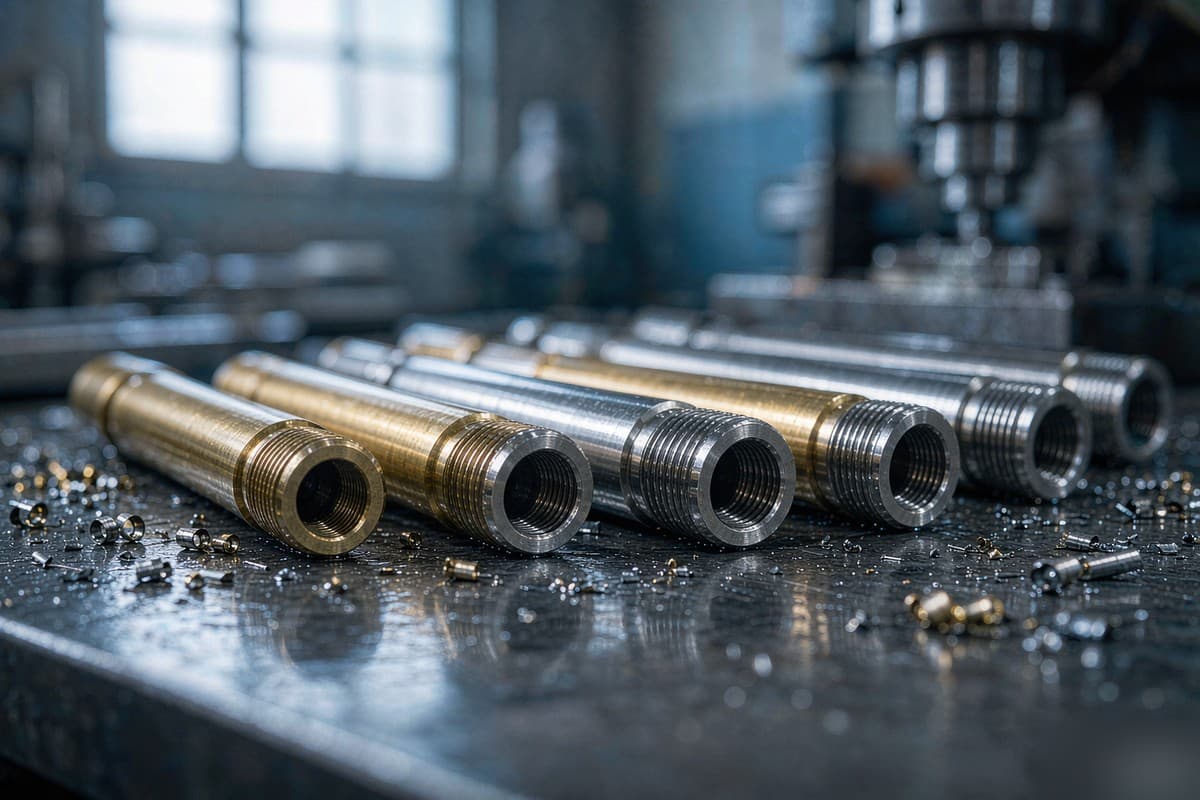
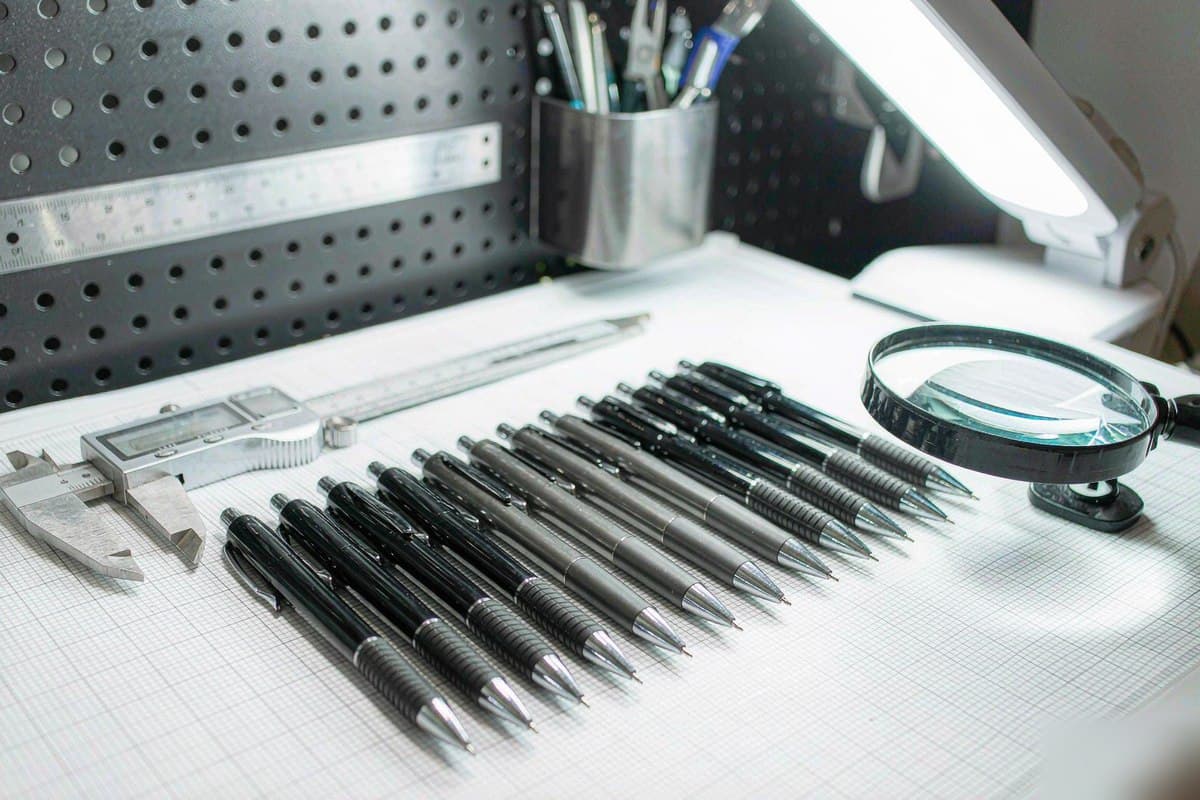
The same order photographed at each stage. The number that matters next to each photo is the working days, because that is what moves when a specification changes.
1 · Material & components
3–5 days
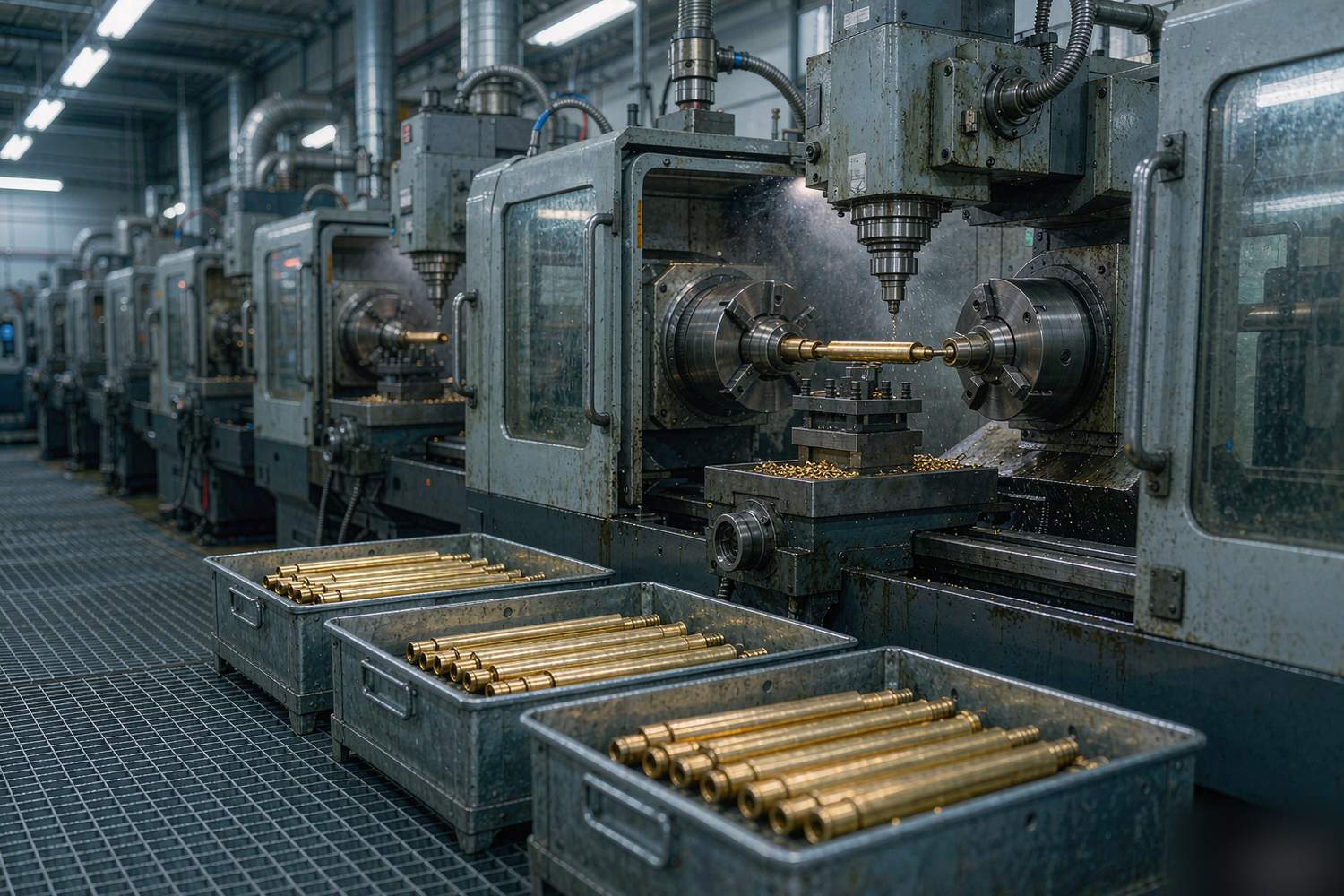
2 · CNC machining
5–8 days
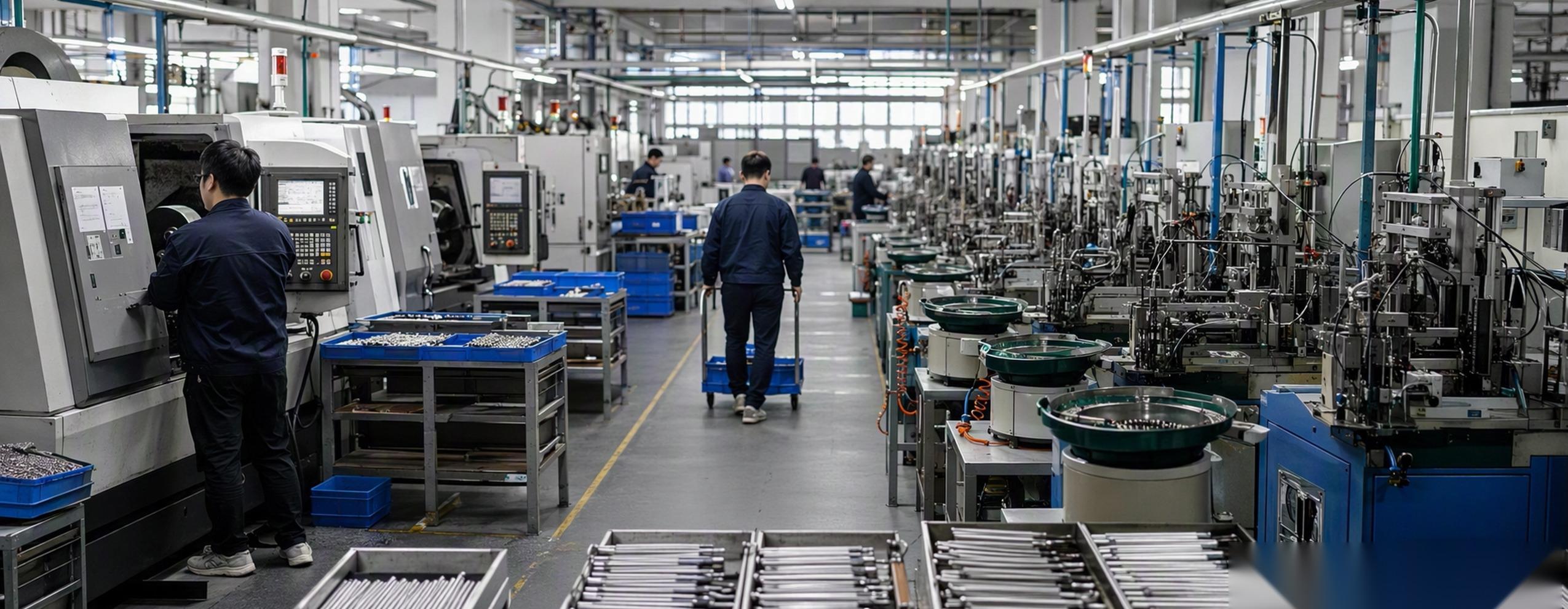
3 · Polishing & plating
7–10 days · longest
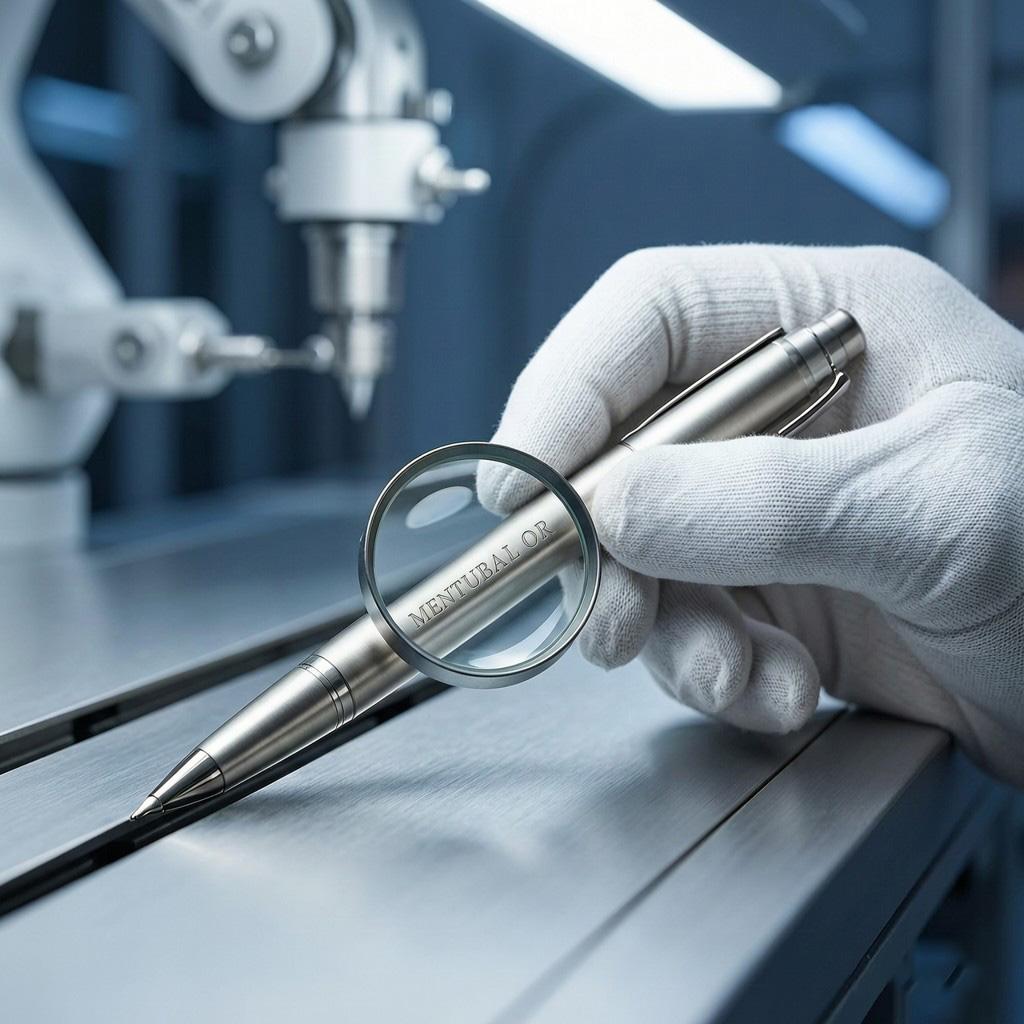
4 · Logo application
3–5 days
5 · Assembly & QC
3–5 days
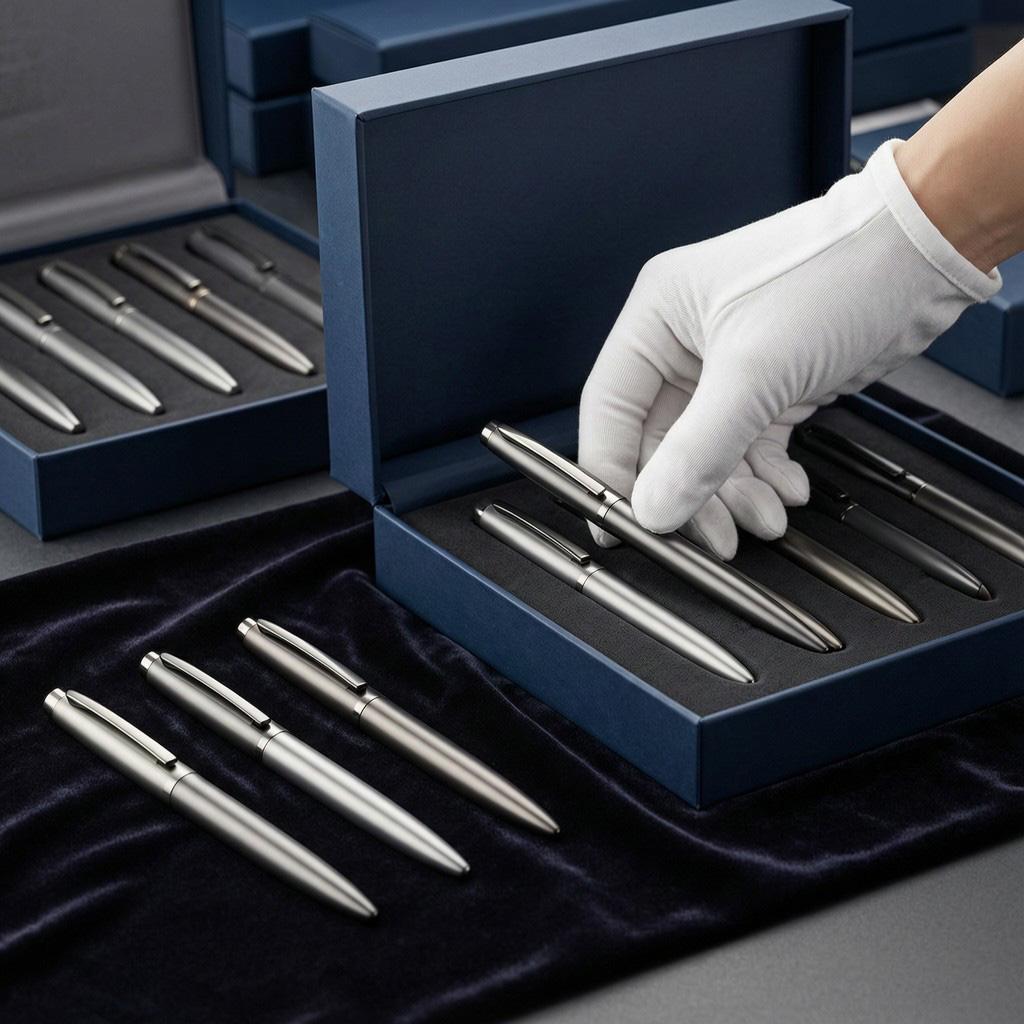
6 · Packaging & packing
3–7 days
Six stages of a 30–45 day build, photographed on our line. Numbers assume a normal 1,000–5,000 unit run with a stock plating tone and one logo position.
| Stage | Typical duration | What makes it longer |
|---|---|---|
| 1 · Material & components | 3–5 days | Special non-stock brass or aluminium alloys, custom clip shapes, custom spring colours |
| 2 · CNC machining | 5–8 days | Complex multi-section barrels, double-colour anodising, tight dimensional tolerances |
| 3 · Polishing & plating | 7–10 days | Dual-tone plating, matte + gloss combinations, soft-touch rubber paint, antique finishes |
| 4 · Logo application | 3–5 days | Multiple logo positions, full-wrap engraving, multi-colour UV printing |
| 5 · Assembly & QC | 3–5 days | Three-stage inspection, individual serial numbering, certificate of conformance per carton |
| 6 · Packaging & packing | 3–7 days | Rigid gift boxes with custom inserts, individual polybags with barcodes, retail display trays |
Two things consistently extend a timeline more than buyers expect. The first is surface finishing — a single-tone plating is routine, while a dual-tone finish needs a second cycle with masking, and complex anodising adds steps. The second is packaging: a rigid gift box with an insert is assembled by hand, and hand-assembly does not scale the way machining does.
Both are covered in detail in our breakdown of what really drives your unit cost, and packaging formats are visible in the gift box range.
Work backwards, not forwards. Fix the date the pens must arrive, then subtract each block — including the ones buyers forget.
| Step | Working days before delivery | Notes |
|---|---|---|
| Shipping and customs | 25 – 40 | Sea freight is cheaper and slow; air is fast and expensive. Decide early — this choice alone can swing three weeks. |
| Production | 30 – 45 | Starts only after PP sample approval |
| Custom logo sample | 7 – 10 | Plus your internal approval time — usually the real delay |
| Quotation and specification | 2 – 5 | Allow for one round of revision |
| Artwork preparation | 3 – 7 | Often overlooked; see the artwork rules |
Read as a single rule: allow roughly 12 to 14 weeks from first enquiry to delivery for a custom-branded metal pen programme. Shorter is possible, but it comes from decisions made early, not from pressure applied late.
What not to compress. Refill grade, packaging protection and inspection depth are the three things worth protecting even on a rushed order — they are also the three a supplier under pressure will quietly reduce. Our QC and compliance process runs three inspection stages on every order regardless of lead time.
The fastest way to compress a quotation from days to hours is to send the five things a supplier has to ask about anyway. Missing items become a round of emails, and each round costs a day.
| Send this | Why it matters |
|---|---|
| Quantity, and whether it is firm or indicative | Determines tooling amortisation and whether tiered pricing makes sense |
| Artwork, in vector | Decides the branding method and the number of setups |
| Target delivery date and destination | Sets the freight mode and whether the timeline is feasible at all |
| Packaging format | The variable that most often surprises buyers on both price and lead time |
| Any compliance requirement | Which documents must be issued with the order — see the compliance guide |
If you do not have artwork ready, a description is enough to get an indicative quote — but treat that number as a range, not a price.
1,000 units for a custom-branded metal pen, which is the level that covers machine setup, plating preparation and logo tooling. Stock models without branding can often be ordered from 100–500, and stock pens with laser engraving sometimes from 500.
Sometimes, but expect to absorb the setup cost in the unit price — a 500-unit order can cost noticeably more per pen than a 1,000-unit one. If your volume is genuinely small, ask about stock models with engraving rather than a fully custom build.
Stock samples ship within 48 hours and are normally free. A custom logo sample takes 7–10 working days and carries a setup charge, usually refundable against the production order. Always request a pre-production sample before the full run.
Because the time is in surface finishing and hand assembly, not in making the barrel. Polishing and plating alone run 7–10 days, and gift-box packaging is assembled by hand. Machining is comparatively quick.
Yes. Split shipments to multiple venues are routine. Provide the delivery window and destination at quotation stage so freight can be planned into the timeline rather than added on afterwards.
Tell us your quantity, artwork and the date the pens need to arrive. We will confirm the MOQ for your level of customisation, quote the sampling and production stages separately, and tell you plainly if the timeline is not achievable — within 24 hours.
