Custom OEM Metal Pens Manufacturer & Global Supplier
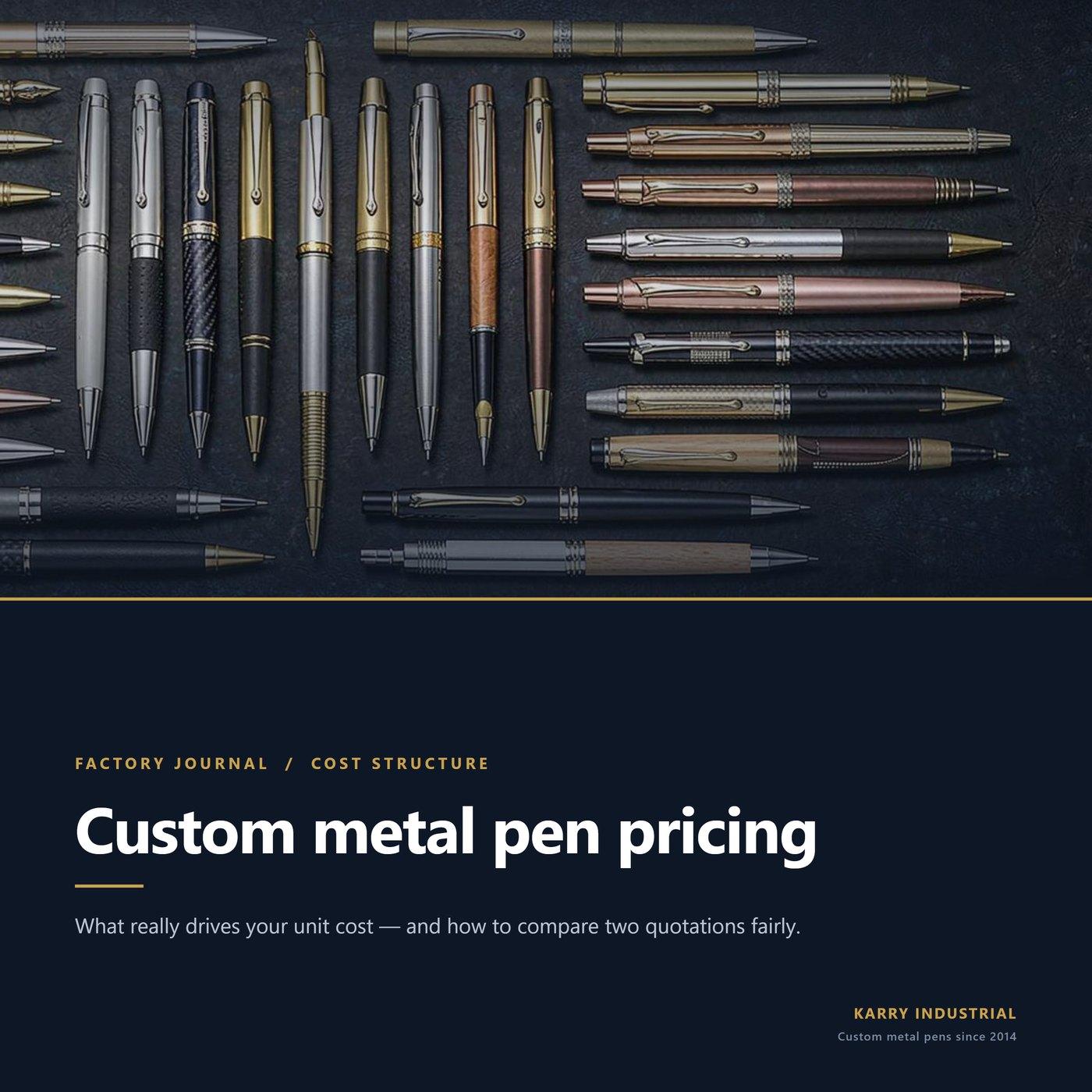
Two suppliers quote the same pen. One comes back at $1.85. The other comes back at $2.60. The drawings look identical. Neither price is dishonest — they are quoting two different objects, because “a metal pen” describes a range, not a specification.
Karry Industrial has been manufacturing metal ballpoint and rollerball pens for promotional distributors, corporate gifting companies and stationery brands since 2014. Quotation requests arrive every day, and one question keeps coming back: why is this more expensive than the quote I got somewhere else?
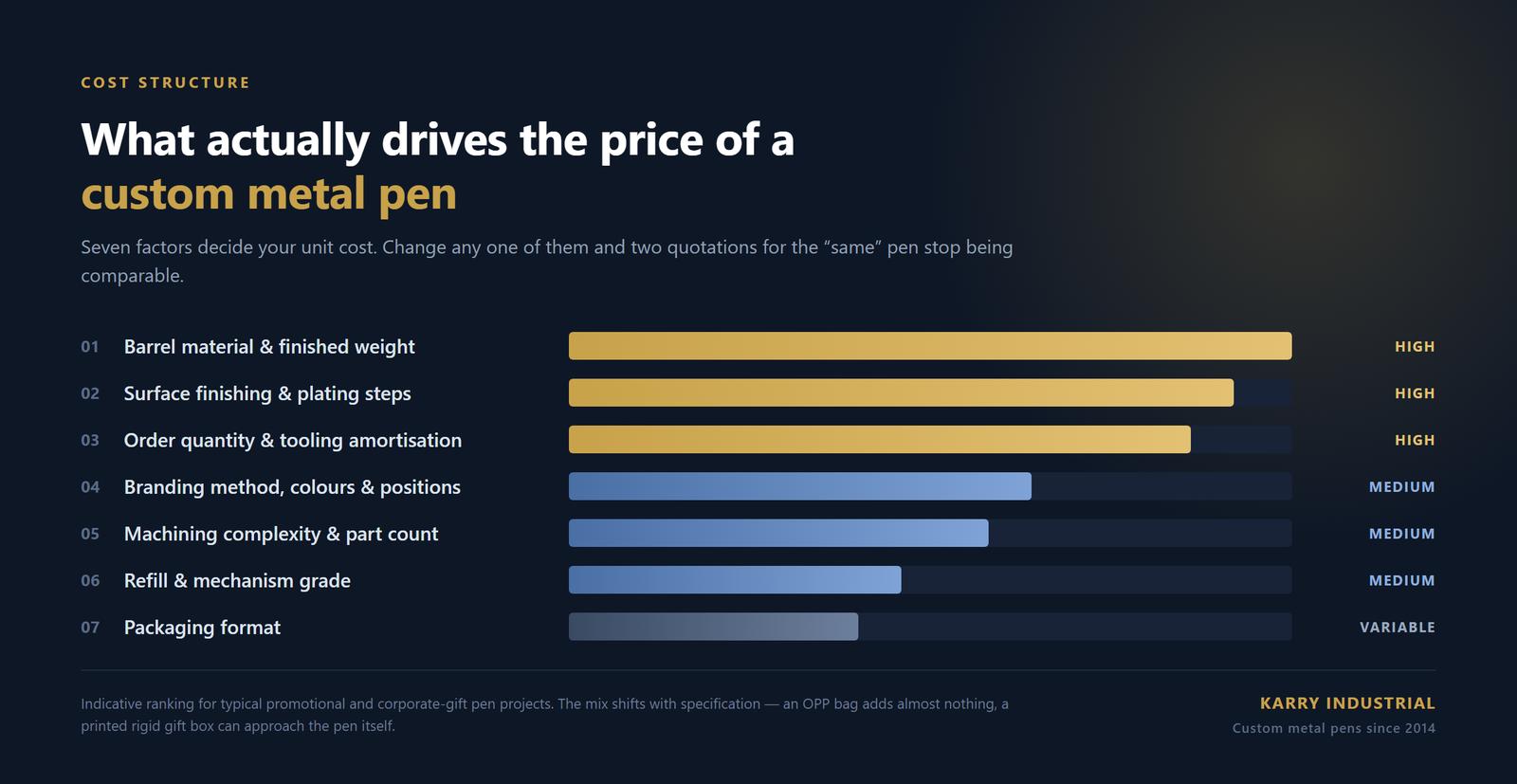
This article breaks a custom metal pen into the seven factors that actually decide the unit price, so you can compare quotations on equal terms — and see exactly where your money goes.
A quotation is not a price for a product. It is a price for a specification. When a brief says “brass ballpoint, black finish, logo printed”, it leaves at least seven things open:
Change one of these and the price moves slightly. Change three and the two quotations stop being comparable at all. It is the most common reason buyers believe they are being overcharged when they are not.
The ranking below reflects typical promotional and corporate-gift projects. The mix shifts with specification — but material, finishing and quantity are almost always where the money is.
Material is usually the largest single line in the quotation, and the reason is simple: you are buying metal by volume.
Weight is not only a cost driver, it is a perception driver. A heavier pen reads as more expensive in the hand — which is why “quote me a heavy pen cheaply” is a contradiction worth understanding early. For a full comparison, see Brass, Aluminum, or Stainless Steel? Choosing the Right Material for Custom Metal Pens.
A machined barrel is bright, raw and easily scratched. Finishing gives it colour, protection and the tactile quality a customer judges within two seconds of picking it up.
Two-colour plating — a bright barrel with a contrasting cap, for example — means two plating passes and a masking step. More handling, more cost, and the fastest way to make a standard shape look bespoke.
Unit price falls as quantity rises, and not only because of volume discounts. Several costs are fixed and simply get spread across more pieces:
Custom branding typically starts at 1,000 pieces. Below that, fixed costs dominate and unit pricing becomes uncomfortable for both sides. If your first order has to be small, the honest conversation is about which parts of the specification to standardise — not about squeezing the unit price.
Branding is applied after finishing, so your mark sits on the final surface rather than being worked over later. The method changes both cost and durability:
Two multipliers matter more than the method itself: how many colours, and how many positions — barrel, cap, clip, and sometimes the gift box. A one-colour engraved barrel logo is the cheapest strong option. A four-colour print on barrel and cap is a different order of cost. For the trade-offs, see Laser Engraving vs. Screen Printing.
Every additional component is another set of turning operations, another tolerance to hold, and another assembly step. A simple one-piece body with a push-on cap is not the same object as a pen built from a barrel, nose cone, centre ring, clip, top button and end cap.
We do our machining in-house, which matters more than it sounds: programme adjustments are made at the machine rather than negotiated with an outside workshop. That is usually the difference between a fast sampling cycle and a slow one. It also means tolerance problems — thread pitch, bore diameter, clip groove depth — are caught before they reach a finished batch, rather than twelve months later as returns.
The refill is a small share of the unit price and a large share of the customer experience. It is the wrong place to save money.
A premium barrel with a cheap refill produces a pen that feels expensive for a week and disappointing for a year.
Packaging has the widest range of any line in the quotation. The same pen can ship in an OPP bag or in a printed rigid gift box, and the difference in cost is substantial.
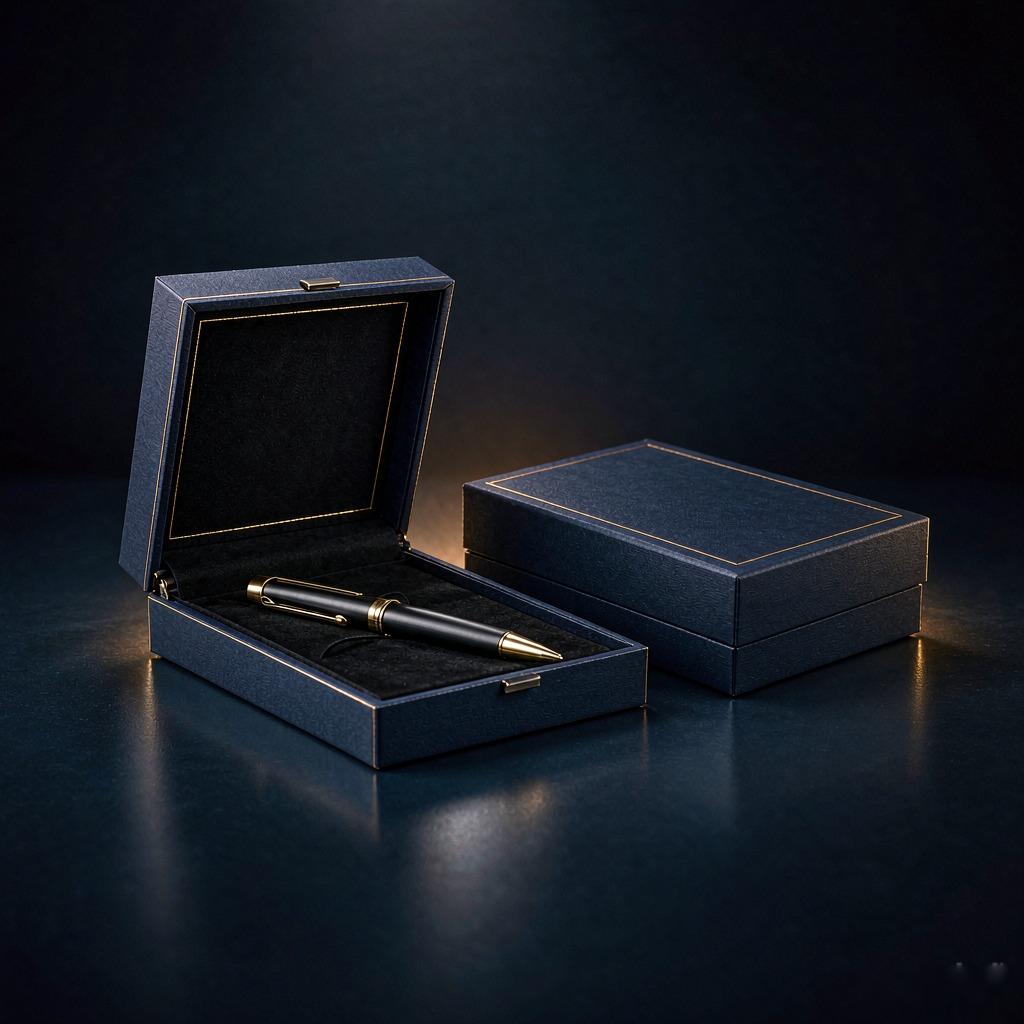
Packing also carries hand-work: placing, bagging, boxing and carton marking are labour, and labour is priced. Tell us the end use and we will quote the packing that suits it, rather than the most expensive one.
Three savings look attractive on a spreadsheet and reliably come back as complaints:
Compliance sits in the same category. All Karry pen materials are 100% REACH and RoHS compliant, and documentation can be supplied with your shipment for customs or retailer review. For European and North American retail, that is not an upgrade — it is a condition of entry, and removing it only moves the problem to the border.
Because the price depends on the specification, the fastest route to a usable number is a brief that answers the seven points above — even roughly. Our process is deliberately short:
For the physical stages behind those numbers, see Inside Our Factory: The Metal Pen Manufacturing Process, Step by Step. For how each batch is checked, see Quality Control & Compliance.
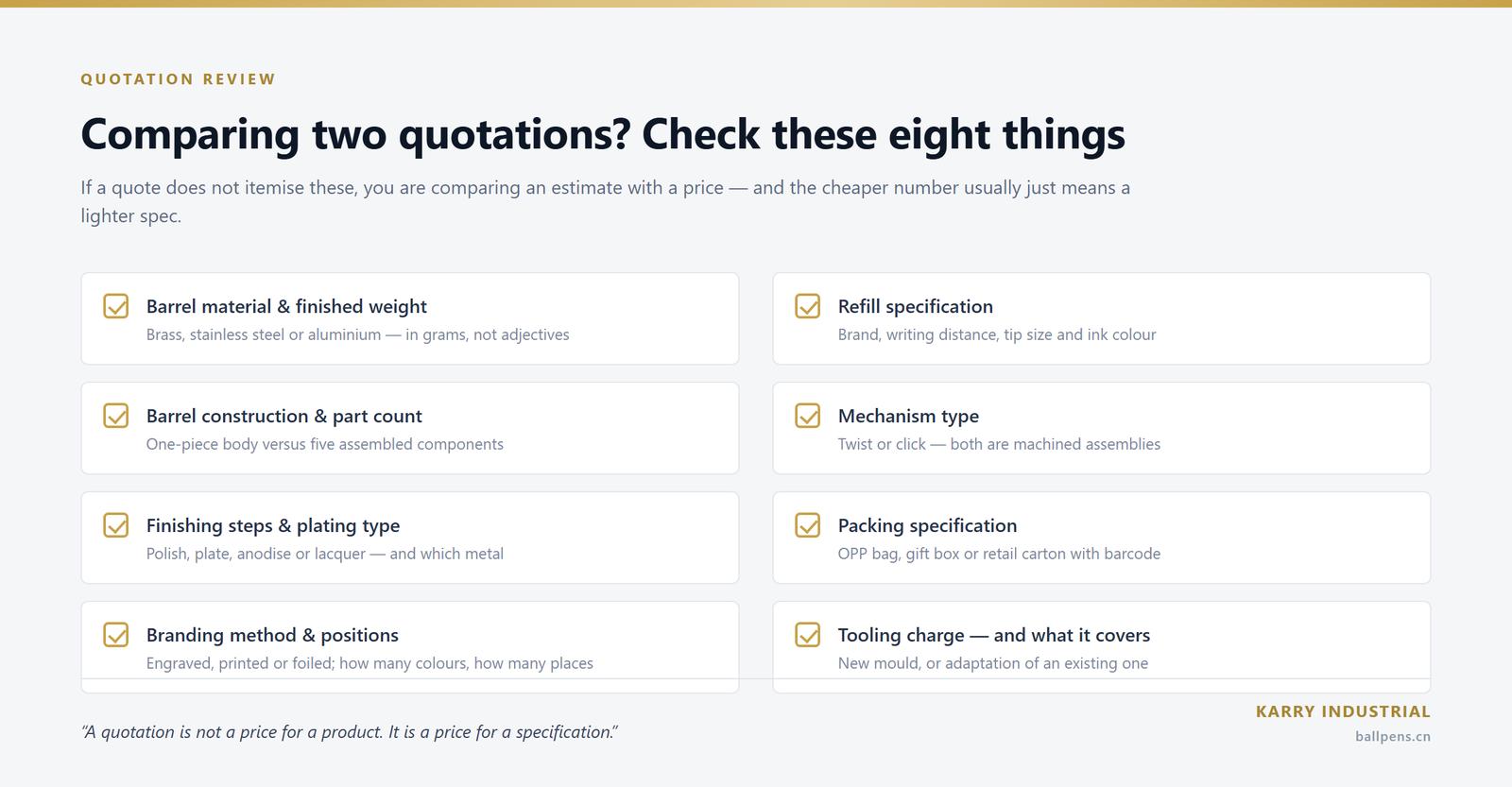
Ask for these eight items in writing. A supplier who can itemise them is quoting; a supplier who cannot is estimating — and the cheaper number usually just means a lighter specification.
| Specification item | What to ask for |
|---|---|
| Barrel material & weight | Brass, stainless steel or aluminium — stated in grams, not adjectives |
| Construction & part count | One-piece body versus five assembled components |
| Finishing & plating | Number of polishing steps and which plating metal |
| Branding method & positions | Engraved, printed or foiled; how many colours, how many places |
| Refill specification | Brand or grade, writing distance, tip size, ink colour |
| Mechanism | Twist or click, and how the action is tested |
| Packing specification | OPP bag, gift box or retail carton with barcode |
| Tooling charge | New mould or adaptation of an existing one — and what the fee covers |
Online prices almost always describe the cheapest possible version of the product: aluminium or plastic rather than brass, no branding, a generic refill, an OPP bag, and a very high quantity. Add your material, your finish, your logo and your packing, and you are pricing a different object. A like-for-like comparison is only possible between two itemised quotations.
Only if your shape cannot be produced from one of our existing moulds. Custom branding itself — engraving or printing your logo — involves a nominal setup or plate fee, and that fee is refundable once the bulk order is placed.
Yes, and you should always ask. Request unit pricing at two or three order levels so you can see how much of the price is fixed cost and how much is material and labour. That single table settles internal discussions about quantity faster than anything else.
Not always, but weight is a good proxy. Heavier generally means more metal by volume, and metal is the largest material line. If two quotations for the same drawing differ sharply, ask for the finished weight in grams on both — it explains the gap more often than anything else.
Send us your specification — or simply your artwork and the intended end use — and we will come back with itemised pricing at quantity breaks and a firm lead time, usually within one working day.
Get your quotation within 24 hours
Send a drawing, an artwork file, or just a description of what you need. We will tell you honestly what drives the price on your project — and where there is room to reduce it.
Request a free quote Request free samples Browse the metal pen range
