
Custom OEM Metal Pens Manufacturer & Global Supplier
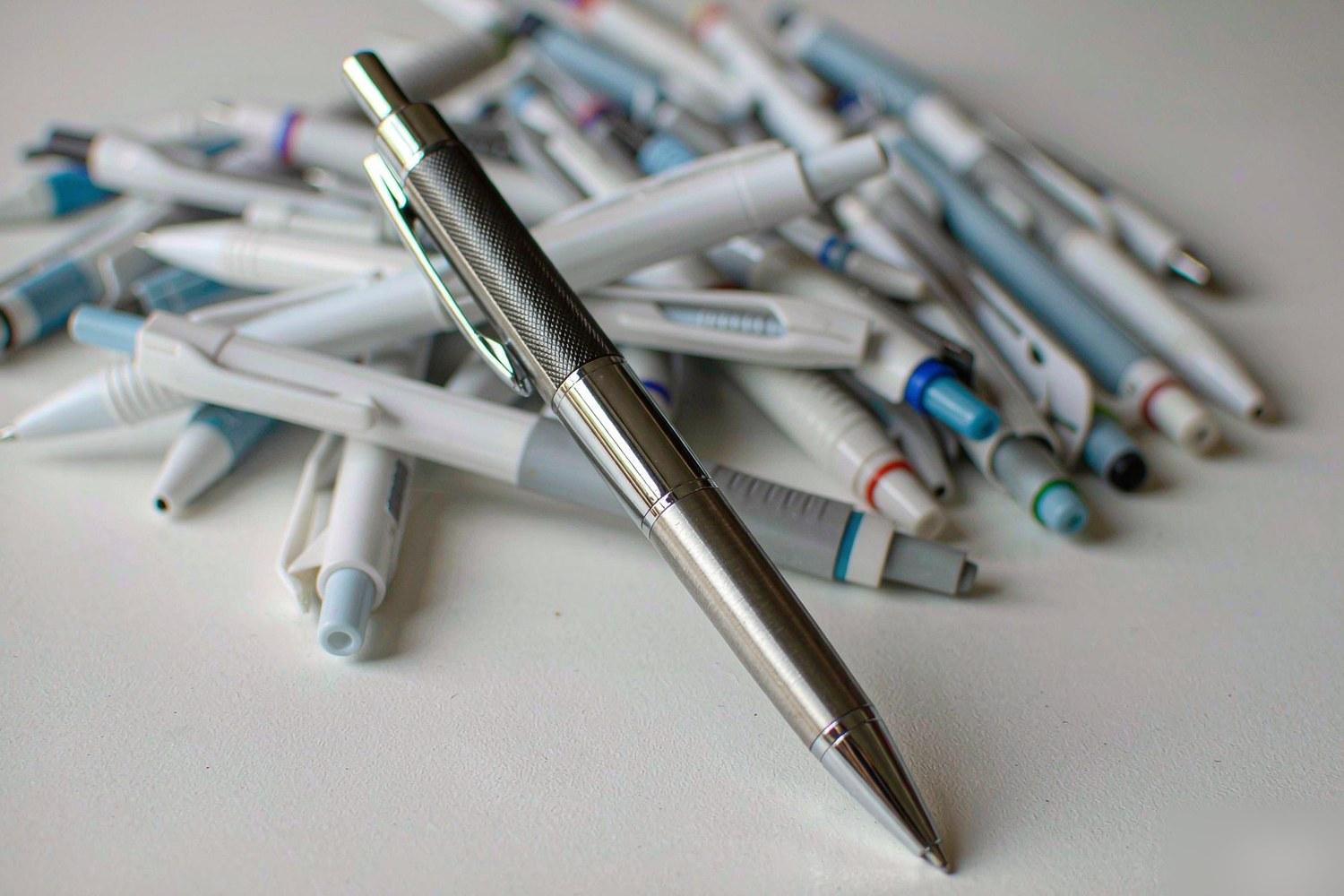
A plastic promotional pen costs somewhere between eight and thirty cents. A decent metal one costs between one and three dollars. That is a four- to ten-fold difference, and it is the reason most procurement teams default to plastic without running the numbers.
The problem is that the comparison is usually made on the wrong basis. Buyers compare unit cost, when what actually lands on the budget is cost per year of useful life — and those two numbers behave very differently, because a metal pen survives the year and a plastic one usually does not.
This article runs the arithmetic properly, then tells you the three cases where plastic is still the right answer. We make metal pens, so treat our conclusion with the suspicion it deserves — but the numbers below are yours to check.
Forget “premium feel” for a moment. There are six measurable differences, and only three of them usually decide the question.
| Dimension | Plastic pen | Metal pen | Why it matters |
|---|---|---|---|
| Unit cost | $0.08 – $0.30 | $1.00 – $3.00+ | The only number most buyers compare |
| Useful life | 1–4 months typical | 2–5 years | Drives the entire calculation below |
| Retention rate | Often discarded quickly | Frequently kept and reused | Determines whether the impression happens once or daily |
| Weight & shipping | ~6–10 g per pen | ~20–45 g per pen | Metal costs more to ship — see the break-even note below |
| Branding fidelity | Print wears off | Engraving is permanent | A worn logo is worse than no logo |
| Refillability | Rarely refillable | Standard Parker-style G2 in most models | Turns a one-off purchase into a repeat relationship |
Two of these deserve a closer look, because they are the ones that get argued about.
A cheap plastic pen does not usually break. It gets lost, or the clip snaps, or the print rubs off and it stops being a branded object at all. In practice, promotional plastic pens have a working life of a few months before they are either gone or unbranded. Metal pens get put in a drawer, used for signatures, and kept — which is exactly what you paid for.
This is the one genuine disadvantage of metal that nobody mentions. A 30 g metal pen weighs three to five times what a plastic one does, and on air freight that difference is real. It is not enough to change the decision — the per-unit saving from plastic is far larger than the shipping penalty — but it does mean the cost gap narrows slightly at high volumes going by air. Sea freight largely erases it.

Here is the calculation that changes minds. Assume a company hands out 5,000 branded pens a year to clients, prospects and staff.
| Plastic route | Metal route | |
|---|---|---|
| Unit cost | $0.15 | $1.40 |
| Units ordered, year 1 | 5,000 | 5,000 |
| Year 1 spend | $750 | $7,000 |
| Units needed, year 2 | 5,000 (previous batch gone) | ~800 (replacements only) |
| Year 2 spend | $750 | ~$1,120 |
| Year 3 spend | $750 | ~$1,120 |
| Three-year total | $2,250 | $9,240 |
| Refill cost, 3 years | n/a — pens are replaced | ~$0.35 × 5,000/yr = $5,250 if you supply refills |
| Three-year total with refills | $2,250 | $14,490 |
Read that last row carefully, because it is where most “metal is cheaper in the long run” arguments quietly fall apart. Metal pens do not save you money. Even accounting for a longer life, a metal programme costs several times what a plastic one does over the same period.
So do not buy the cost argument. If your goal is to put a branded object into as many hands as possible for the smallest possible budget, plastic wins and it is not close. Metal is not a cost-saving measure — it is a quality-of-impression measure. Buy it for that reason and you will be happy with it. Buy it expecting to save money and you will feel cheated by year two.
If metal is not cheaper, what is the $7,000 buying? Four things, in rough order of how often they justify the spend.
Three situations, and they are more common than metal suppliers like to admit.
Choose plastic when…
Choose metal when…
Once the numbers are on the table, the decision usually stops being either/or. The pattern we see most often among established B2B buyers is a two-tier programme:
| Tier | Audience | Spec | Typical volume split |
|---|---|---|---|
| Tier 1 — reach | Trade shows, mailings, general enquiries | Plastic or entry-level metal, single-colour print | ~80% of units, ~20% of budget |
| Tier 2 — relationship | Named accounts, contract signings, staff milestones | Metal, laser engraved, in a gift box | ~20% of units, ~80% of budget |
This gets you breadth where breadth matters and quality where quality is remembered. It also means the metal pen is not competing with the plastic one — it is doing a different job.
If you go this route, specify both at the same time. Doing them as one order usually reduces the metal tier’s setup cost, because the artwork and colour decisions are already made.
Before you commit, understand that “metal” spans a wide range. Brass, aluminium and stainless steel differ in weight, cost, colour options and how well they take a logo — we cover the full comparison in Brass vs Aluminium vs Stainless Steel. Two things are worth knowing up front:
One question that separates good metal quotes from bad ones: “What is the plating thickness, in microns?” A supplier who machines and plates in-house will answer immediately. A reseller will change the subject. Our cost driver breakdown explains where that money actually goes.
You do not have to take any of this on faith. Run a small trial:
A trial at this scale costs a few hundred dollars and removes all the guesswork. It is also the fastest way to find out whether your recipients care about the upgrade — which is the only variable that actually matters here.
Not automatically. A metal pen takes more energy and material to produce, so the environmental case only holds if it is genuinely kept and refilled for years. The claim is defensible when you can document refill usage; it is greenwashing if the pens are thrown away after one event. Our ESG sourcing guide covers how to make the claim hold up.
Expect three to ten times the unit cost of a basic plastic pen, depending on material, finish and branding method. At 5,000 units a year that is typically a few thousand dollars more annually — a real budget line, which is why the hybrid approach exists.
Yes, because they weigh three to five times as much. On sea freight the difference is negligible; on air freight it is noticeable but still smaller than the per-unit price gap. Ask for the shipped weight per carton when you request a quote.
Yes, but not with laser engraving. Full-colour work on metal is usually done with UV printing or pad printing. Laser engraving produces a single-tone mark by removing material, which is more durable but not multicoloured. See the branding method comparison.
It depends on whether your design needs new tooling. Stock models with a logo typically start lower than fully bespoke barrels. Our MOQ guide breaks this down by customisation level.
Tell us how many pens you hand out a year and what you currently pay. We will send back a like-for-like metal quote at the same quantity, with the shipped weight and the three-year arithmetic laid out — so you can decide on your own numbers rather than our adjectives.
