Custom OEM Metal Pens Manufacturer & Global Supplier
Custom OEM Metal Pens Manufacturer & Global Supplier
Sustainability has moved out of the marketing department and into procurement. Between EU Green Deal requirements, corporate ESG scorecards and supplier codes of conduct, buyers are increasingly asked to justify not just what a promotional product costs, but what it is made of, how long it lasts, and what happens to it afterwards.
Most sustainability conversations in this industry focus on tote bags, water bottles and apparel. Pens rarely come up — which is odd, because pens are among the most heavily distributed promotional items in existence, and almost all of them are single-use plastic by design.
This guide is written for buyers who need a defensible answer, not a slogan. It covers what actually makes a pen sustainable, why refill standard matters more than material, how to quantify the reduction for an ESG report, and which documents to request from a supplier before signing off.
A disposable ballpoint pen is a small object with an awkward afterlife. It combines several materials in one unit — plastic barrel, metal tip, ink reservoir, frequently a rubber grip — bonded and assembled in a way that most municipal recycling streams cannot separate. In the absence of a take-back scheme, that usually means the pen is not recycled: it goes to landfill or incineration. Where an organisation does run a collection or take-back programme, that assumption changes — and so does the arithmetic further down this article.
Individually that is trivial. At programme scale it is not. An organisation distributing 10,000 pens a year across events, onboarding kits and client mailers is putting 10,000 mixed-material non-recyclable objects into circulation annually, and doing it deliberately, in the name of brand building.
That is the tension procurement teams are now being asked to resolve: the item is effective marketing and poor environmental performance at the same time.
What this article does not claim. We do not claim that a metal pen is automatically the lower-impact choice. Whether it is depends on four variables, and only one of them is about the pen itself:
- Material — virgin brass, recycled aluminium and stainless steel do not carry the same footprint per gram.
- Manufacturing energy — machining, plating and anodising are energy-intensive compared with injection moulding.
- How long it is actually reused — the largest variable, and the one nobody can guarantee at the point of purchase.
- What happens at end of life — recovered through a metal stream, or landfilled.
We have not commissioned a life cycle assessment (LCA) for any of our pens, and we therefore do not claim that they are better over the full life cycle. What we can defend is the refillable-and-kept-for-years case, and the plastic-reduction arithmetic below. A supplier who says their metal pen is “more sustainable” without quantifying those four variables is giving you a slogan, not a specification.
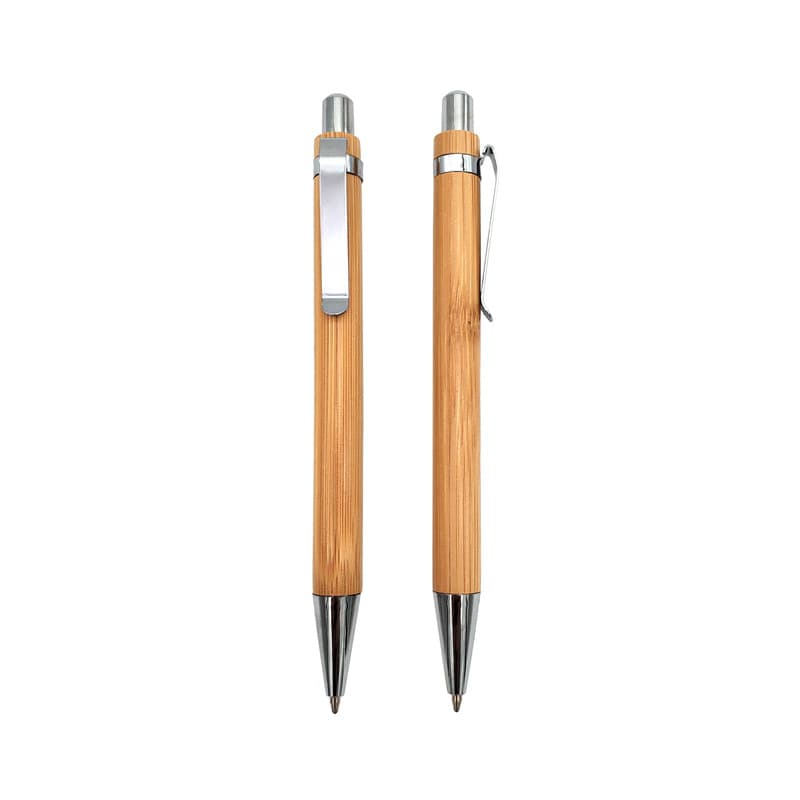
This is where most programmes go wrong. “Eco-friendly pen” is not a specification, and suppliers are happy to use it loosely. Four attributes are measurable, and these are the ones worth writing into a purchase order:
A caution on claims. “Biodegradable” and “oxo-degradable” plastic pens exist and should be treated carefully. Many require industrial composting conditions that the recipient will never have access to, and oxo-degradable plastics fragment into microplastics rather than breaking down. If a supplier cannot state the disposal condition required, treat the claim as unverified.
A refillable pen that takes a proprietary cartridge is sustainable in theory only. If the user cannot buy a replacement at a local stationery shop, in a hotel gift shop or from a corporate supply catalogue, the pen stops being used the day the ink runs out — and you have manufactured a heavier version of the disposable pen you were trying to replace.
This is why the Parker-style G2 refill has become the de facto global standard for metal ballpoint pens. It is widely stocked across North America, Europe and Asia, available in multiple ink colours and line widths, and lets the end user choose. Schmidt EasyFlow 9000 and equivalent cartridges follow the same pattern.
When you write the specification, ask three questions and get all three answered in writing:
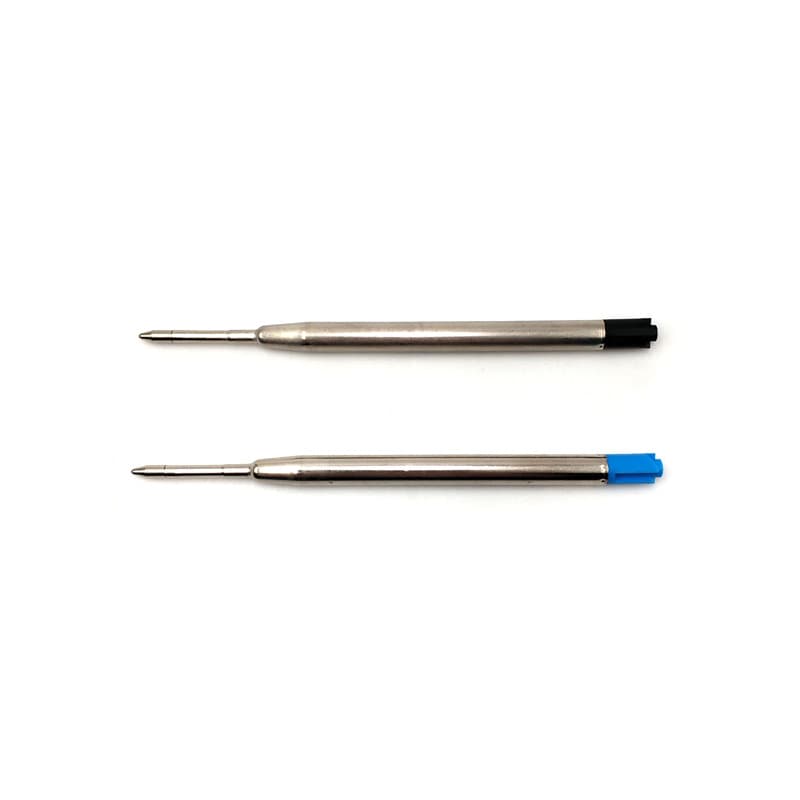
Standard refill
The Parker-style G2 refill — the de facto industry standard, stocked by stationery retailers across North America, Europe and Asia. Shown in black and blue.
Fits in the barrel
A G2 refill seated in a metal barrel. Tip and barrel separate, so the user replaces only the refill and the pen stays in service.
A typical Parker G2 refill and metal pen pairing — select either to view the model and request a quote.
You can review compatible options in our pen refill range. Refill grade also affects writing experience directly — see how it features among the seven cost drivers of a custom pen, and why it is one of the three specifications that should never be cut to hit a price target.
Procurement teams usually need a number, and the instinct is to ask the supplier for one. Be careful: any figure a supplier hands you is built on assumptions you have not seen, and an auditor will ask where it came from.
Better approach — use a formula with your own inputs, and state the assumptions alongside the result. Here is a defensible structure:
Plastic units avoided
Q = number of pens in the programme
R = expected refills per pen over its service life
Units avoided = Q × R
Plastic mass avoided
W = average mass of one disposable plastic pen (typically 8–12 g — ask your incumbent supplier for the actual figure)
Plastic avoided (kg) = Q × R × W ÷ 1,000
Worked example: 5,000 pens, each refilled an estimated 20 times over its service life, against a disposable pen averaging 10 g — that is 100,000 pen units avoided and roughly 1,000 kg of mixed-material plastic not placed into waste streams.
Always publish the assumptions with the number. The refill-rate estimate (R) is the sensitive variable — it is an assumption about user behaviour, not a measured fact. Stating it openly is what makes the figure defensible under review. A supplier who will not discuss where the numbers come from is not giving you a number you can use.
Two limits to be explicit about, because an auditor will raise both. First, this formula counts plastic avoided — it is not a carbon figure and must not be presented as one. Second, if your organisation genuinely needs a carbon or whole-of-life number, that requires a formal life cycle assessment to ISO 14040 and ISO 14044, or the EU Product Environmental Footprint (PEF) method. We have not carried one out for any of our pens, and a supplier who says they have should be asked for the report and the boundary conditions, not a summary slide.
Sustainability claims and regulatory compliance are related but separate, and both belong in the supplier questionnaire. For pens distributed in the EU, UK and North America, the commonly requested set is:
| Document | What it covers | Why it matters |
|---|---|---|
| REACH conformity | Registration, evaluation and restriction of chemical substances — EU market | Required for import into the EU. Covers inks, plating and coatings, not just the base metal. |
| RoHS | Restriction of hazardous substances in materials | Frequently requested alongside REACH; increasingly a default line in supplier codes of conduct. |
| Prop 65 (California) | Warning requirements for listed substances | Relevant whenever pens are distributed or resold into California. |
| EN 71-3 | Migration of certain elements — toy safety standard | Requested when pens are aimed at children or distributed in educational settings. |
| FSC certification | Paper and board from responsibly managed forests | Applies to packaging and any bundled notebooks — not to the pen itself. |
| Recycled content declaration | Percentage of recycled material in the barrel | The document that turns “eco-friendly” into a number you can report. |
Request these at quotation stage, not after the order is placed. A supplier with genuine documentation produces it quickly; one without it will stall, and that delay is itself an answer. Our quality control and compliance page lists what we issue as standard.
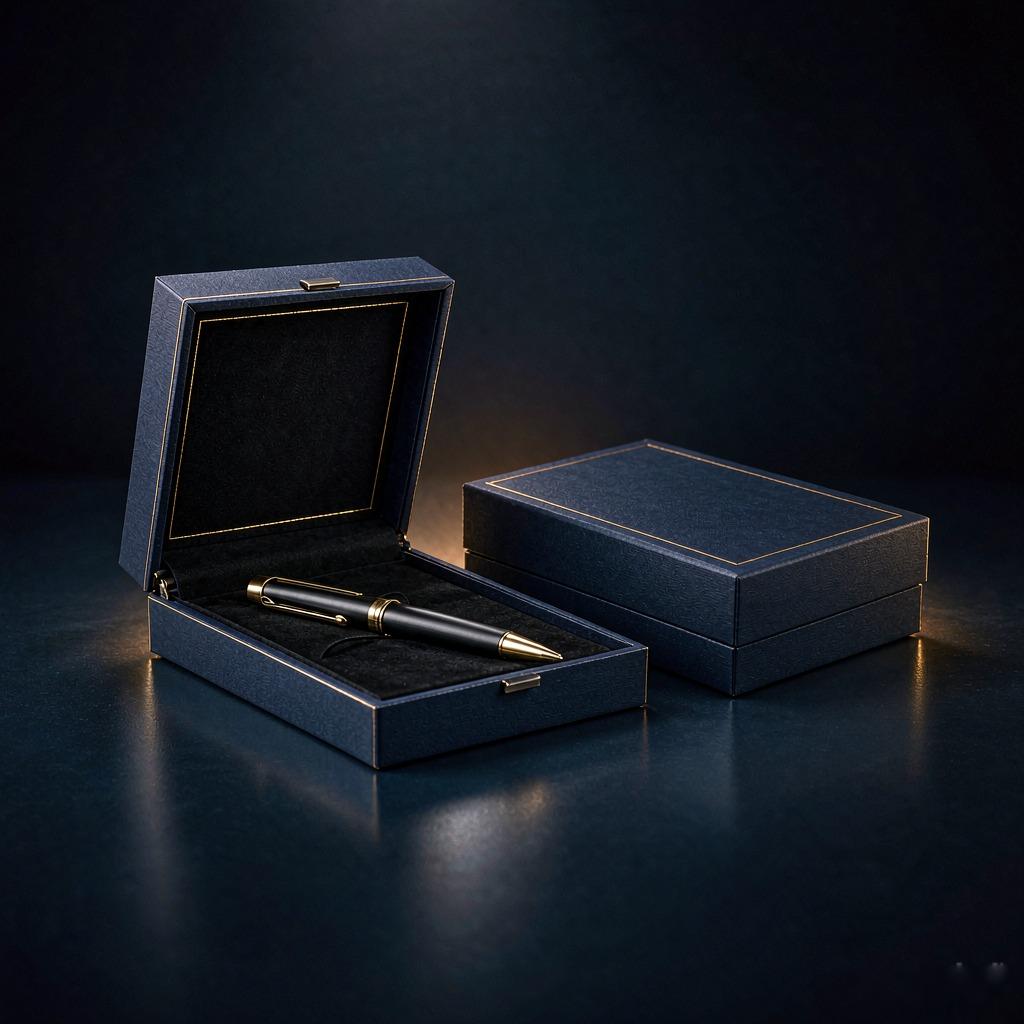
Packaging is the most common gap in an otherwise credible programme. A recycled-brass refillable pen arriving in a laminated plastic blister with a PVC insert has given away most of the argument at the last step — and recipients notice, because packaging is the part they see first and judge fastest.
Practical alternatives that hold up at volume:
These take five minutes and will separate a genuine programme from a greenwashed one:
Yes, on two conditions: the refill standard must be widely available (Parker-style G2 or equivalent), and the packaging must not reintroduce single-use plastic. Without the first, the pen gets discarded when the ink runs out; without the second, you have moved the problem rather than solved it.
Parker-style G2 as standard across the metal ballpoint range, which is stocked by stationery retailers and corporate supply catalogues in North America, Europe and Asia. Schmidt EasyFlow 9000 and equivalents are also supported. Confirm the format on your specific model at quotation stage.
Yes — both are issued as standard. Prop 65 statements for California distribution and EN 71-3 for educational programmes can be provided on request. Ask at quotation stage so documentation is bundled with the order rather than chased afterwards.
Yes. Recycled kraft boxes and sleeves are available across most volume tiers, with FSC-certified board on request. Rigid gift boxes can be specified with paper-based inserts instead of plastic trays.
Not necessarily. More metal means more material per unit, but a brass or stainless barrel that stays in service for years and is recoverable at end of life displaces dozens of disposable pens. Service life dominates the calculation — which is exactly why refill standard is the specification to get right. See our material comparison for the trade-offs.
Tell us your quantity, target market and which compliance documents you need. We will come back with a specification including refill standard, recycled-content declaration, plastic-free packaging options and the documentation set — everything you need before it reaches an auditor.
