Custom OEM Metal Pens Manufacturer & Global Supplier
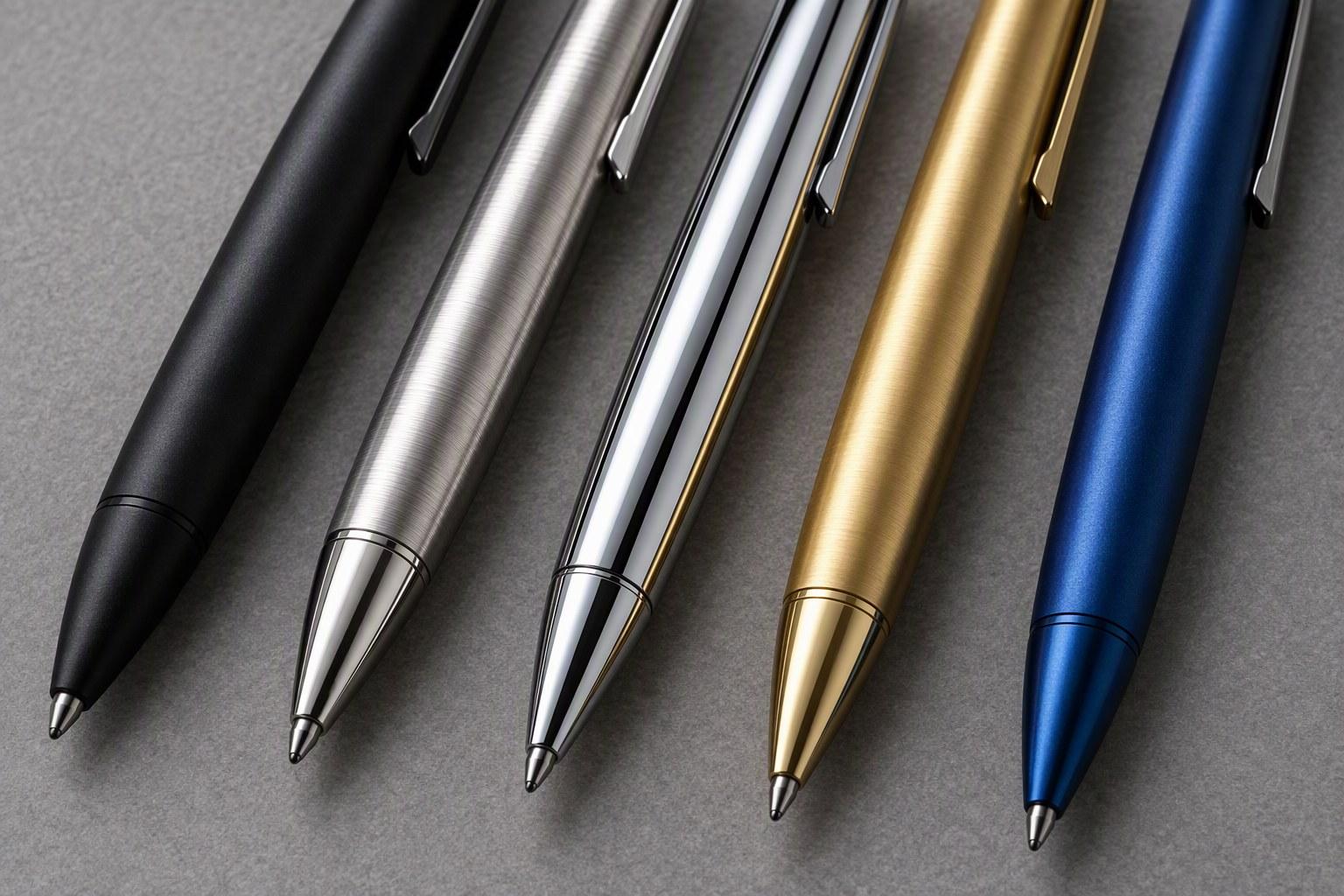
Two metal pens can use identical barrels and carry identical logos, yet cost twice as much as each other. The difference is almost always in the finish — the surface treatment applied after machining — and it is the specification buyers find hardest to evaluate from a photograph.
Finish decides three things: how the pen looks and feels, how it survives a year in a pocket, and whether your chosen branding method will actually work on it. Get it wrong and the failure appears months after delivery, when the plating lifts or the colour drifts between batches.
This is a plain-language guide to the seven finishes you will be offered, what each one costs, and how to test them before committing.
| Finish | How it is applied | Relative cost | Wear resistance | Colour range | Laser-friendly |
|---|---|---|---|---|---|
| Anodised | Electrochemical oxide layer on aluminium | Medium | Very high — the layer is part of the metal | Wide, including deep colours | Yes — excellent contrast |
| Chrome plated | Electroplated chromium over base metal | Medium | High — hard, but can flake at edges | Silver / mirror only | Poor — reflective surface scatters |
| Gold / rose-gold plated | Electroplated precious-metal layer | High | Medium — wears through with heavy use | Gold tones only | Moderate |
| Lacquered | Sprayed paint layer, often several coats | Low to medium | Medium — chips at impact points | Very wide, any Pantone | Yes, but mark is less crisp |
| Sandblasted / matte | Abrasive blasting of the bare surface | Low | High — no coating to wear off | Natural metal tones only | Yes — subtle contrast |
| Brushed / satin | Directional abrasion of the surface | Low | Very high — scratches blend in | Natural metal tones only | Yes — low contrast |
| Polished / mirror | Progressive mechanical polishing | Medium | Low — shows every fingerprint and scratch | Natural metal tones only | Poor |
Anodising grows an oxide layer out of the aluminium itself rather than adding a coating on top. Because the layer is part of the metal, it cannot peel or flake — it wears down gradually, and a scratch does not lift a film the way it does with plating or lacquer.
It also takes dye exceptionally well, which means anodised aluminium can hold deep, saturated colours while remaining a metal object rather than a painted one. And it is the ideal surface for laser engraving: the laser removes the dyed layer to expose the lighter metal underneath, producing a mark with strong contrast that will never fade.
Why this matters for aluminium pens: anodising is only possible on aluminium, which is the lightest of the common pen metals. If weight is a concern — large orders going by air, or recipients who prefer a lighter pen — anodised aluminium gives you colour and durability without the mass of brass. See the aluminium pen range, or compare the metals in Brass vs Aluminium vs Stainless Steel.
Electroplating deposits a thin layer of metal — chrome, nickel, gold or rose gold — onto the barrel. It produces the mirror-bright finish most people picture when they imagine a “premium” pen, and on a well-made barrel it looks excellent for years.
The failure mode is delamination. Plating adheres to a prepared surface, and if the preparation is rushed or the layer is too thin, the coating can lift at edges, at the clip, or at the threads where the barrel screws together. Once plating starts to flake, the pen looks damaged and there is no repair.
Ask for the plating thickness in microns. This is the single most useful question you can ask about a plated pen. A serious manufacturer knows the number and will state it; a reseller will not. Very thin decorative plating is the main reason a metal pen can be quoted suspiciously cheap — and the reason it looks tired within a year. Our cost driver guide explains where plating sits in the unit price.
One practical note: highly reflective chrome and polished finishes are poor surfaces for laser engraving, because the mirror surface scatters the beam. If you want both a bright finish and a laser mark, ask about a satin or brushed variant instead — it reads as premium without the engraving problem.
Lacquer is sprayed paint, usually in several coats with curing between them. It gives you essentially unlimited colour — any Pantone reference can be matched — which makes it the finish of choice when your brand colour is the whole point.
Its weakness is impact. Lacquer is a coating sitting on top of the metal, so a knock against a desk edge can chip it and expose the barrel underneath. The edges of the cap and the clip are the vulnerable points. Thicker multi-coat lacquer with a clear top coat resists this considerably better than a single sprayed layer, and the price difference between the two is small — worth specifying.
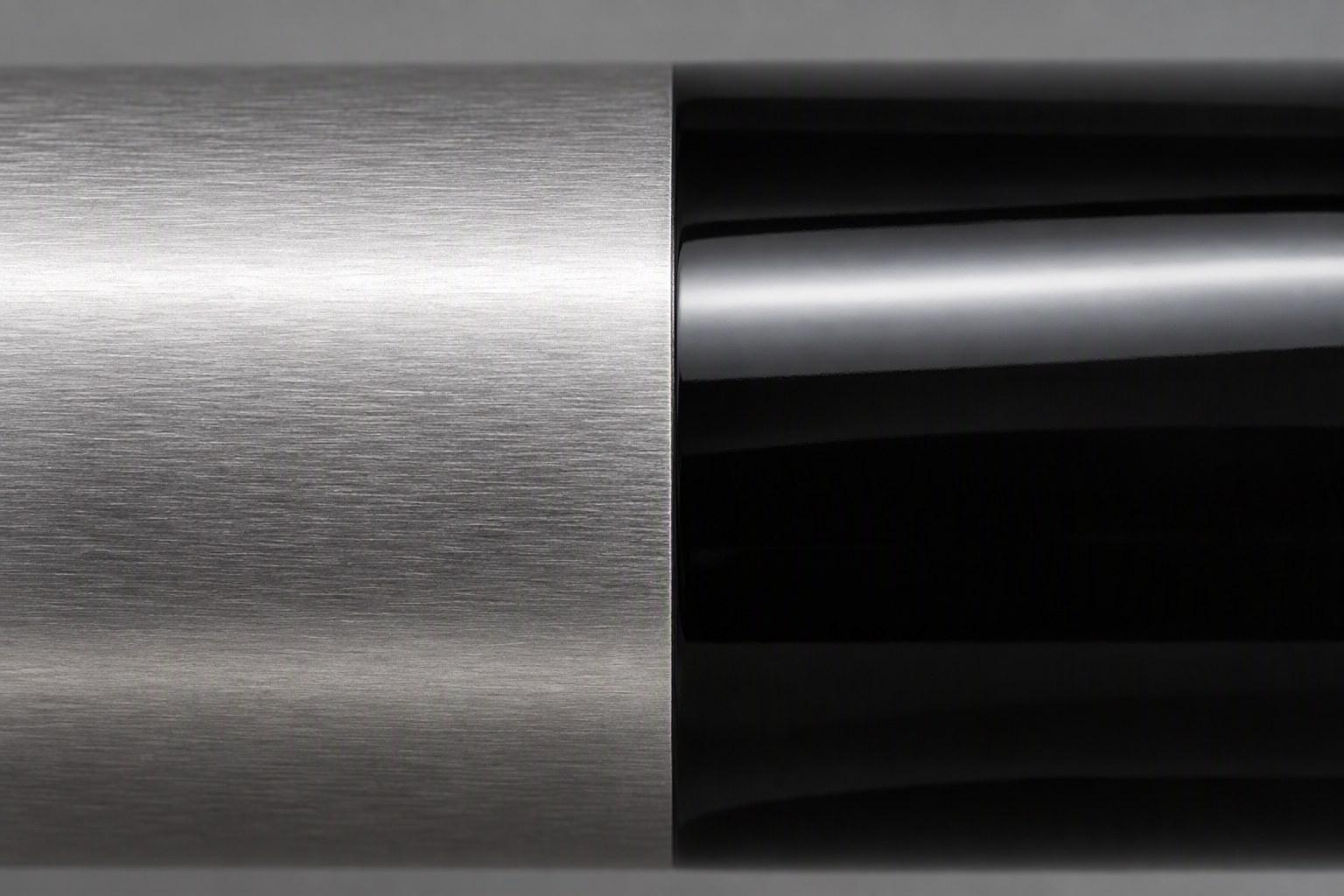
These three finishes treat the metal surface itself rather than adding anything to it, which makes them the most durable options available — there is simply nothing to wear off.
For brass, an unlacquered brushed or sandblasted finish has an additional property worth knowing: the metal develops a patina over time, darkening gradually with handling. Some buyers consider this a feature — the pen acquires character — while others want a consistent appearance across a batch. If consistency matters, specify a lacquered or plated brass rather than raw. Our wood and brass range shows both approaches.
Not every finish accepts every branding method, and mismatches are a common cause of disappointing samples. The practical pairings:
| Finish | Laser engraving | Screen / pad printing | UV printing |
|---|---|---|---|
| Anodised aluminium | Excellent — high contrast | Good | Good |
| Chrome plated | Poor — reflective | Good | Good |
| Gold plated | Moderate | Good | Good |
| Lacquered | Good, lower contrast | Excellent | Excellent |
| Sandblasted | Good — subtle, tonal | Moderate | Good |
| Brushed | Moderate — low contrast | Moderate | Good |
| Polished | Poor | Good | Good |
The general rule: coated surfaces favour printing, uncoated surfaces favour laser. If your logo is a single colour and you want permanent marking, an uncoated finish with laser engraving is the most durable combination available. If you need multiple colours, you need a printed method and therefore a surface that takes ink — lacquer or plating. The full comparison is in Laser Engraving vs Screen Printing vs UV Printing.
What goes wrong
- Plating lift — flaking at clip, cap edge or threads within 6–18 months
- Lacquer chipping — impact marks exposing bare metal, usually at the cap rim
- Colour drift — batch 2 does not match batch 1, most often with anodising and lacquer
How to test before ordering
- Salt spray — ask for a corrosion test result on plated samples
- Abrasion — rub a sample against denim for 30 seconds, check for colour transfer
- Tape test — press adhesive tape onto plating, pull sharply, look for lifted flakes
- Cross-batch comparison — request samples from two different production runs and view them in daylight, not under office lighting
Two of these are worth insisting on for any significant order. The tape test costs nothing and detects a plating adhesion problem in seconds. And comparing samples from two production runs is the only reliable way to catch colour drift before it affects a whole order — anodising in particular can vary between dye baths.
Always judge colour in daylight. Warehouse and office lighting shifts how metal finishes appear, and buyers regularly approve a sample under fluorescent light and then reject the delivered batch viewed outdoors. If colour accuracy is critical, ask for the sample to be photographed in natural light and compare that image with the delivered goods under the same conditions.
Anodising on aluminium, and any of the uncoated mechanical finishes — brushed, sandblasted or polished — because there is no applied layer to wear off. Plating and lacquer are both coatings, and coatings eventually fail at the edges.
Yes with lacquer, which takes any Pantone reference. Anodising has a wide but finite dye range and produces slightly different results on different alloys, so exact matching is harder. Plating is limited to metal tones — chrome, nickel, gold and rose gold.
Almost always insufficient plating thickness or inadequate surface preparation before plating. Ask for the thickness in microns before ordering — a serious manufacturer will state it, and the number predicts how the finish will hold up.
It produces a subtler mark than anodised or coated surfaces, because there is less contrast between the engraved area and the surrounding surface. For a strong, visible logo, anodised aluminium gives the best contrast of any finish.
Yes — finishing is one of the larger variable costs in a metal pen. Plating and multi-coat lacquer cost noticeably more than a mechanical brushed or sandblasted finish, and gold plating is the most expensive of the common options.
Photographs are a poor substitute for holding the object. Tell us which finishes you are considering and we will send samples in the same barrel shape so you can compare weight, texture and colour in daylight before you commit to a production run.
