
Custom OEM Metal Pens Manufacturer & Global Supplier
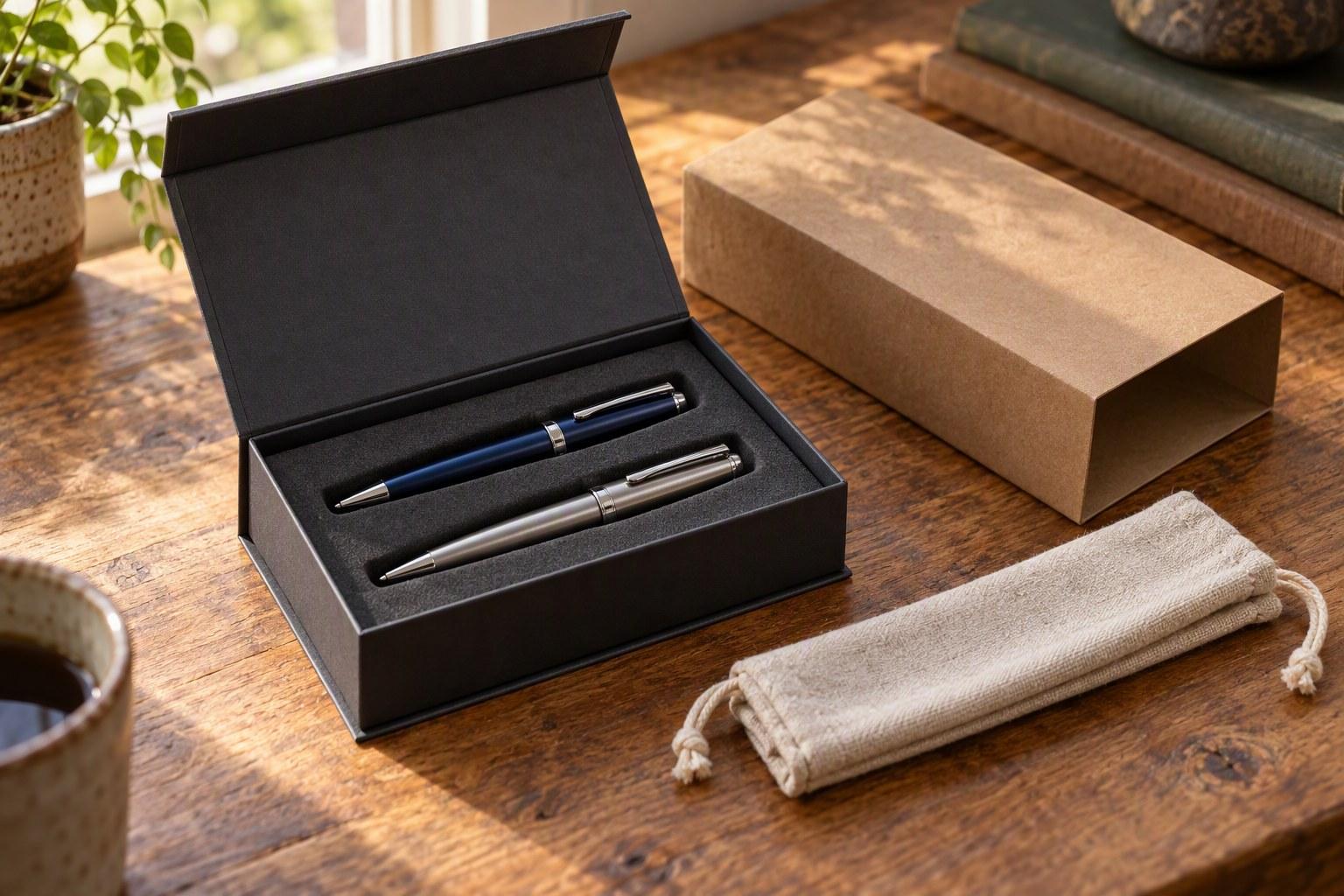
A pen is handed over once. The box is what the recipient opens, holds and remembers in the first thirty seconds — which is precisely when their impression of your brand is being formed. It is also the part of a corporate gift order that buyers most often leave until the last minute, and then regret.
Packaging does three jobs: it protects the pen in transit, it carries your branding, and it frames the moment of receiving. The right format depends on which of those three matters most for your programme. Get it right and a $2 pen can feel like a $20 gift; get it wrong and you have spent more on the box than on what is inside it.
Here are the six formats we are asked for most often, what each one costs relative to the others, and how to choose.
| Format | Relative cost | Typical MOQ | Branding space | Protection | Best for |
|---|---|---|---|---|---|
| Cardboard sleeve | Lowest | Low | Large, flat surface | Minimal | Volume giveaways, mailings |
| Folding cardboard box | Low | Low | Lid, base, sides | Good | Everyday corporate gifting |
| Rigid gift box with insert | Medium | Medium | Lid top, sides, inner lid | Excellent | Client gifts, executive gifting |
| Window box | Medium | Medium | Lid top and sides | Good | Retail-style presentation, sets |
| PU leather / velvet pouch | Medium | Medium | Limited — debossing or small plate | Moderate | Travel, hotel, conference |
| Wooden or metal case | Highest | High | Laser engraving on lid | Excellent | Milestone awards, VIP gifting |
A printed sleeve or a simple folding carton is the cheapest way to add a branded container to a pen order. Both pack flat before assembly, which keeps freight cost low, and both accept full-colour printing across large areas — so you can reproduce artwork, a campaign message or a QR code at almost no additional cost.
What they do not do is feel special. A folding carton reads as packaging rather than as a gift, which is entirely appropriate for a trade show giveaway and entirely wrong for a client thank-you. If your recipients are strangers, use a sleeve. If they are named accounts, keep reading.
Typical options in this group: Cardboard Pen Gift Box BJ01, the Recycled Cardboard Pen Gift Box BZ02 for an eco-positioned programme, and the BZ03 with ribbon closure when you want a small step up in perceived quality for very little cost.
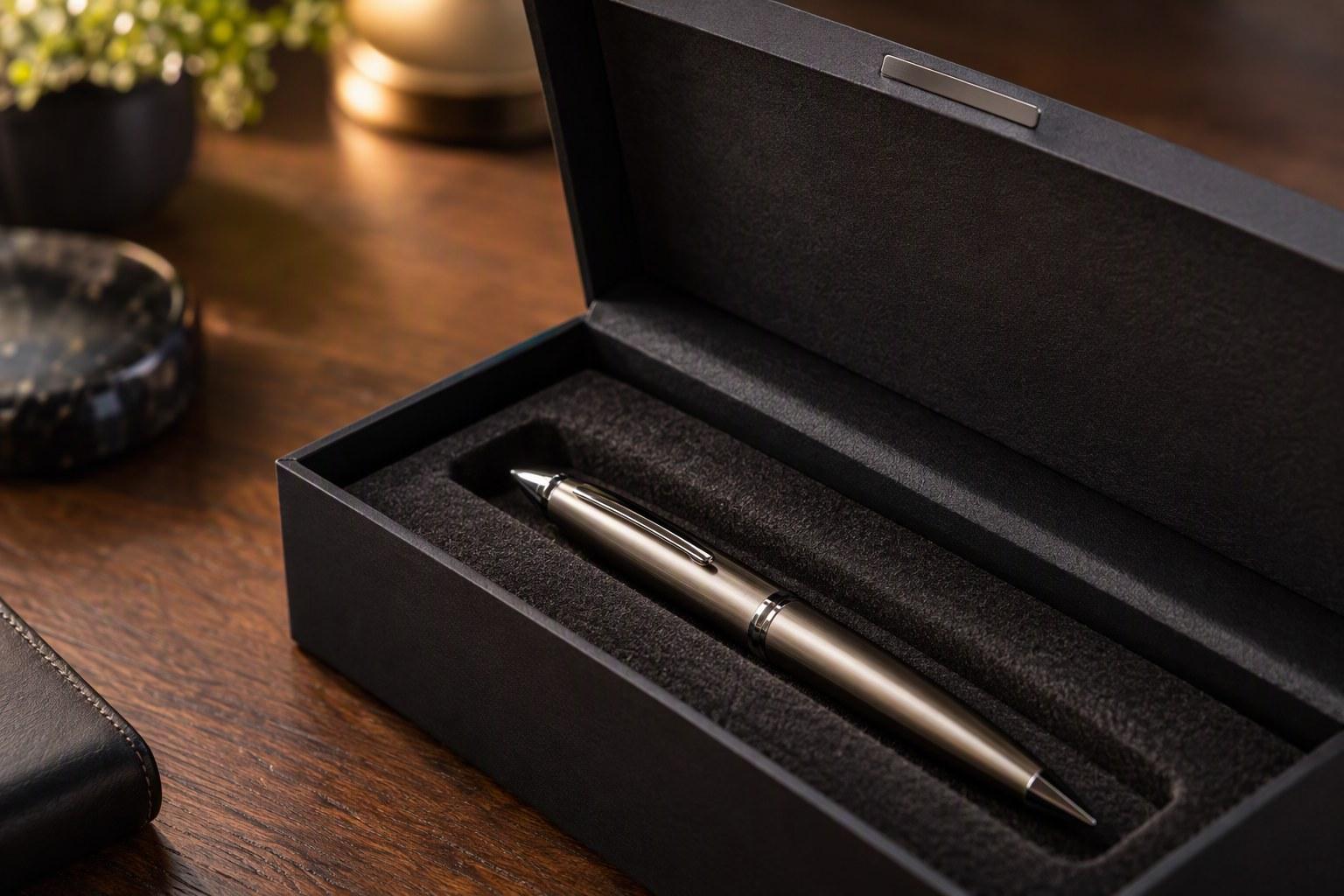
A rigid box has a solid board structure that holds its shape when opened. It feels substantial in the hand, it does not deform in transit, and the lid can be lifted slowly — which is the whole point. This is the format most corporate gift programmes end up choosing.
The insert matters as much as the box. A foam or moulded insert holds the pen in place, prevents it rattling, and presents it at a slight angle when the lid is raised. Two-pen inserts are worth considering if your programme includes a matching rollerball and ballpoint — a set in a proper insert reads as considerably more valuable than the sum of its parts. See the Foam Insert Two Pen BZ13.
Magnetic closure is the detail that changes how a box feels. A magnetic lid resists slightly when you open it and closes with a soft snap — a small mechanical cue that people read as quality. The cost difference over a friction-fit lid is modest, and it is usually the single best value upgrade in a packaging specification. Example: Magnetic Closure Gift Box BZ08.
A window box pairs printed board with a transparent panel so the pen is visible before the lid is lifted. This works well when the pen itself is the selling point — an engraved barrel, an unusual finish, a distinctive colour — and when the box may be displayed on a desk or a retail shelf rather than opened immediately.
Two practical points. First, the window material matters: PVC is inexpensive and clear but less environmentally positioned than a paper window, which is opaque but recyclable with the rest of the box. Second, the window must not press against the pen — contact between plastic and a plated or lacquered barrel can mark the finish over time, particularly in warm conditions.
Options: BZ15 with transparent PVC window and BZ05 custom open window.
A PU leather or velvet pouch is soft, light and compact — which makes it the right choice when the pen will be carried rather than presented. Conference delegate bags, hotel rooms, sales rep samples and travel kits all suit a pouch better than a box, because a box will be left behind and a pouch will be kept.
Branding options are more limited than on a box: a debossed logo, a small metal plate, or a printed tag. That is not necessarily a disadvantage — a subtle debossed mark on a leather pouch often reads as more considered than a large printed logo on cardboard.
Examples: PU Leather Pen Gift Box BJ06 and BJ07 for a hybrid board-and-insert design.
At the top end, cases are made from wood or metal and usually laser engraved rather than printed. These are appropriate for long-service awards, retirement gifts, board-level gifting and anything where the pen is a commemorative object rather than a working tool.
Be aware that a case in this category can cost more than the pen inside it — sometimes several times more. That is not automatically wrong: if the object is meant to sit on a shelf for a decade, the case is part of the gift. But it should be a deliberate decision rather than an accident of specification.
What goes wrong
How to avoid them
The dimension problem is more common than you would expect. Pen diameters vary from around 8 mm on a slim aluminium model to over 13 mm on a heavy brass barrel, and lengths range from about 130 mm to 145 mm. A box that fits one will not fit the other. If you are reordering packaging for a different pen model, re-check the fit rather than reusing the previous specification — this is the single most frequent packaging error we see.
There is a useful way to think about the packaging budget. The recipient does not know what you paid. What they experience is a sequence: the box arrives, it opens, the pen is revealed, they hold it. Packaging controls the first three of those four steps.
| Programme | Suggested format | Packaging as % of unit cost |
|---|---|---|
| Trade show giveaway (thousands of units) | Sleeve or folding carton | 10–15% |
| Client thank-you (hundreds of units) | Rigid box with insert | 20–30% |
| Executive / board gifting | Rigid box, magnetic closure | 25–40% |
| Long-service award | Wooden or metal case | 50–100%+ |
These are guides rather than rules, but they are useful guardrails. If your packaging is coming in well above the band for your programme type, you are probably buying a better box than the occasion calls for. If it is well below, the presentation may undercut the pen.
Two practical advantages to specifying packaging at the same time as the pens rather than as a follow-up order:
If you are working to a budget, the usual sequence is: choose the pen first, then choose the packaging format that fits the occasion, then set a packaging budget as a percentage of the pen cost. Our cost driver guide shows how packaging sits alongside material, finishing and branding in the unit price, and the corporate gifting guide covers how to build the whole specification around a budget tier.
Folding cartons and sleeves have the lowest minimums because they are printed on flat stock. Rigid boxes with a custom insert require tooling for the insert, so the minimum is higher. Tell us your quantity and we will confirm what is achievable at that volume.
Yes, and it is usually worth doing. Printing on the lid of a rigid box or across the face of a sleeve is inexpensive once the box is being produced anyway, and it means the branding is present before the pen is seen.
Yes. Recycled board is widely available for folding cartons and rigid boxes, and FSC-certified stock can be specified. If sustainability is part of your programme’s messaging, mention it early — it affects both the material choice and the documentation you will want to keep. See the ESG sourcing guide.
A printed sleeve adds a small fraction of a cent to a few cents. A rigid box with a foam insert adds considerably more, and a wooden or metal case can exceed the pen cost. The table above gives typical bands by programme type.
Flat, in almost all cases. Assembled boxes take up many times the volume and will be crushed under stacking in a shipping container. Folding cartons and rigid boxes are normally shipped flat with inserts packed separately, then assembled at the point of use.
Tell us the pen model, the quantity and the occasion, and we will recommend a packaging format, confirm the fit against the actual barrel dimensions, and quote pens and packaging together as one delivered price.
