
Custom OEM Metal Pens Manufacturer & Global Supplier
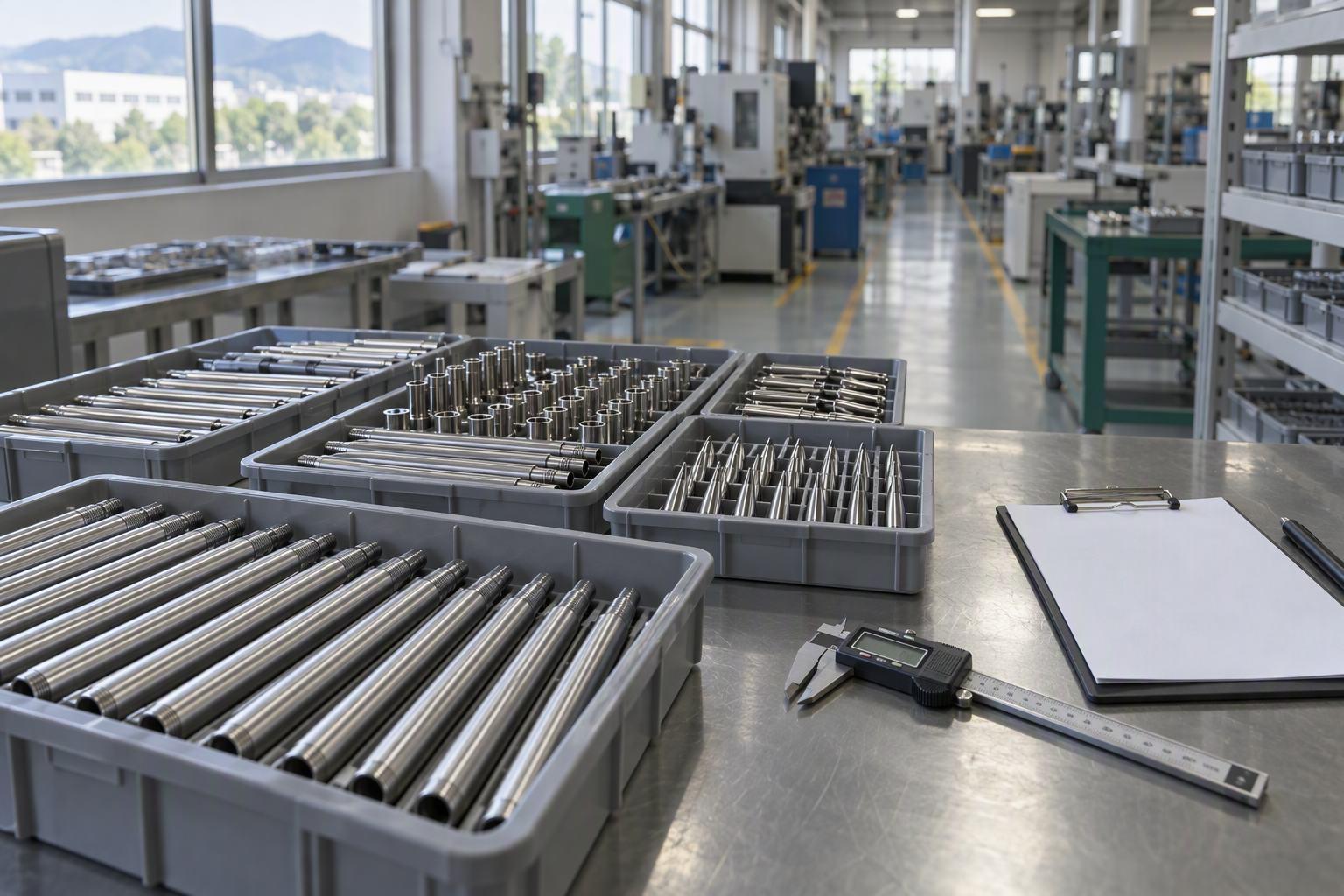
Almost every pen supplier can tell you their quality is good. Very few can tell you what happened on a specific order, what went wrong on it, and what they did about it. The gap between those two things is the gap between a supplier you trust and a supplier you are gambling on.
This article walks through one real order we completed and shipped — 3,000 acid-etched ballpoint pens for a gift supplier in France. It covers the production flow stage by stage, where the quality gates actually sit, and the part that went wrong: a batch of machined components failed the warehouse-entry inspection, we did not have enough of one plastic component to replace them, we re-processed under time pressure, and we shipped three days late.
We are publishing it because the way a supplier behaves when something goes wrong tells you more about them than anything in their sample presentation. Everything below happened as described.
What this article does not disclose. We are not naming the customer, the pricing, the calendar dates, the reject count, or the specific defect that failed inspection. Those details identify a live commercial relationship, and publishing them would not make the article more useful to you. What we are disclosing is the sequence of events, where the gate that caught it sits, and the decision we made about shipping. That is the part that transfers to your own sourcing.
| Item | Detail |
|---|---|
| Product | Acid-etched metal ballpoint pen |
| Quantity | 3,000 pieces |
| Logo method | Stamped — a physical press, which sits deeper in the metal than laser engraving |
| Destination | A high-end gift supplier in France |
| End use | Resold as part of a gift programme — the pen is the product, not the giveaway |
The logo method matters more than most buyers expect. Stamping is deeper than laser engraving, which means it cannot be buffed out and reworked — a mis-stamped barrel is scrap, not a reprint. On a 3,000-piece order where the pen itself is the product being resold, that raises the cost of getting the stamping step wrong and makes the inspection gate that follows it the single most expensive place to find a defect.
An order does not move through one line. It moves through three separate machining tracks that converge at assembly. This is the actual sequence for a pen like this one, with the checkpoint at each stage.
| # | Stage | What happens | Checkpoint |
|---|---|---|---|
| 1 | Order placed | Buyer’s enquiry, specification, artwork and quantity confirmed | Written confirmation of spec before anything is cut |
| 2 | Order review | We check the spec against what we can actually build — tooling, tolerances, finish, quantity | Anything not buildable is raised now, not later |
| 3 | Production order issued | Work order raised internally; the order becomes a manufacturing document | Spec on the work order matches what was approved |
| 4 | Materials ordered | Tube stock, metal and plastic components, refills, packaging ordered against the bill of materials | Material availability confirmed before machining starts |
| 5 | Component machining | Three tracks run in parallel — see the table below | First-off inspection before the run continues |
| 6 | Barrel painting | Barrels through the spray line | Colour and adhesion checked against the approved sample |
| 7 | Component plating | Metal and plastic components through the plating line | Plating thickness and adhesion checked |
| 8 | Inspection before warehouse entry | Machined and finished components inspected before they are released into stock | This is the gate that caught the problem on this order |
| 9 | Assembly | Passed components released to the assembly floor and built into finished pens | Only inspected components enter assembly |
| 10 | Full finished-goods test | Appearance, function and durability tested on the finished pens | Second gate — nothing ships without passing it |
| 11 | Gift packaging | Individually packed into the gift packaging | Packaging checked against the approved mock-up |
| 12 | Bulk packing and dispatch | Cartoned, labelled, staged for shipment | Carton count and labelling verified |
Stage 5 is not one operation. Three separate component families are made in parallel, each with its own equipment.
| Component family | Equipment | Sequence |
|---|---|---|
| Barrel | Tube cutting machine, tube shrinking machine, automatic spray line, printing machine, oven | Cut → shrink → spray → print → cure |
| Metal components | CNC lathe, plating line | Turn → plate |
| Plastic components | Injection moulding machine, plating line | Mould → plate |
All three converge at assembly, which is why a shortfall in any one of them stops the whole order — and why the material check at stage 4 exists. A pen is not finished until the slowest and scarcest component arrives.
There are two gates on this order, and they do different jobs.
Gate 1 — before warehouse entry
- Runs on components, before they are released into stock
- Catches problems while they are still cheap to fix
- Stops a bad component from ever reaching the assembly floor
- This is the gate that caught the problem on this order
Gate 2 — on finished pens
- Runs after assembly, on the completed pen
- Checks appearance, function and durability
- Catches assembly faults that component inspection cannot see
- Last chance before packaging and dispatch
The first gate is the one that saves money, because a defect found there is a component you can remake. The same defect found after assembly is a finished pen you have to strip and rebuild, and found after shipping it is a warranty claim on the other side of the world. How a supplier allocates inspection effort between those two gates tells you how much they understand their own process. If you want the sampling numbers behind gate 2, that is covered in our article on AQL sampling and inspection.
Components came off the machining tracks and went to inspection before warehouse entry. A portion of them did not pass. Those units were pulled and set aside — they were not released into stock and they did not go to assembly.
Then the problem got worse before it got better. When we went to make up the shortfall, we found we did not have enough of one of the plastic components on hand to complete the replacement run. The material that was short was not the part that failed inspection, but it was the part that could not be replaced fast enough.
We arranged re-processing on an expedited basis. That is where the three days came from — not from the inspection itself, but from having to remake components that should have been available when the gate rejected the first batch.
We are not going to tell you the defect type or the reject count, and you should be suspicious of any supplier who would. Those numbers identify the customer and the batch. What matters for your sourcing is the sequence: a gate caught it, the rejects were pulled, the replacement material was short, and the order went late. That is the part that generalises. A supplier who tells you “we have never had a problem” is telling you either that they do not inspect properly or that they do not publish their problems — and both readings are bad.
The rejected units existed, they were built to spec apart from the failed check, and shipping them would have made the order on time. We did not ship them. The reasoning:
Three days late with a clean shipment is a supplier problem you can plan around. On time with a mixed shipment is a supplier problem you discover at the worst possible moment.
We told them before the original delivery date, not after it. That distinction is the whole point of this section.
A delay disclosed before the deadline is information the buyer can act on — they can adjust their own schedule, warn their customer, or ask us to prioritise part of the order. The same delay disclosed after the deadline is a broken commitment, and it reads as concealment even when it was not. The news is identical; only the timing changed, and the timing is what determines whether it is a managed problem or a trust problem.
We told them what had failed, that the units had been pulled, that we were re-processing, what the new date was, and that every pen shipping would have passed both gates. We did not send them the shipment and let them find out.
The honest version of what this cost us. Three days against the schedule, the re-processing run, and the scrapped components. We are not going to dress that up as a win. The point of publishing it is that a supplier who only ever publishes their successes has not told you how they behave on the order that matters.
You can get most of the value of this article without ever having a problem on your own order. These are the questions that separate a documented process from a verbal assurance.
| Ask this | What a good answer sounds like |
|---|---|
| Where do you inspect, and at how many points? | Named gates — before warehouse entry and on finished goods — not “we check quality” |
| What happens to a batch that fails inspection? | Pulled, not released; a decision about scrap versus rework |
| How do you handle a material shortfall mid-order? | A named escalation path, and a realistic new date |
| How would you tell me about a delay? | Before the deadline, in writing, with the reason and the new date |
| Can you walk me through a real order? | A specific sequence of stages with checkpoints, not a brochure |
If a supplier cannot answer the first question, the remaining four are academic. And if you are weighing suppliers at all, the questions in our manufacturer vetting guide cover the ground before you place an order.
Partial shipments split a gift programme across two delivery dates and two sets of packaging, which usually costs the buyer more than a single consolidated shipment three days late. Where a buyer does want a split, we will do it — but it has to be their decision, made with the dates in front of them.
No. Most rejections are caught early enough that the replacement run fits inside the existing schedule. What makes an order late is a reject combined with a material shortfall, which is what happened here. The material check at stage 4 exists precisely to stop that combination.
The gates are the same at any quantity, but the exposure is different. On a smaller order there is less buffer stock to absorb a shortfall, so a material problem is proportionally harder to recover. On a larger order, a rejection is a bigger absolute loss but easier to absorb.
Ask what evidence comes with the shipment. On this order, every pen that shipped had passed both gates, and the inspection outcome is available to the buyer on request. If a supplier cannot tell you what was inspected and what the result was, you are relying on trust, not on a process.
Our standard quoted lead time is 30–45 days from sample approval. That is the planned schedule, not a worst case. On this order the three-day delay sat outside that window because of the re-processing, and it was disclosed before the original date rather than folded into it silently. Lead times, MOQ and sampling are covered in more detail separately.
Tell us the product, the quantity, the logo method and the date the pens need to arrive. We will confirm what is buildable, quote the sampling and production stages separately, and tell you plainly if the timeline is not achievable — within one business day.
